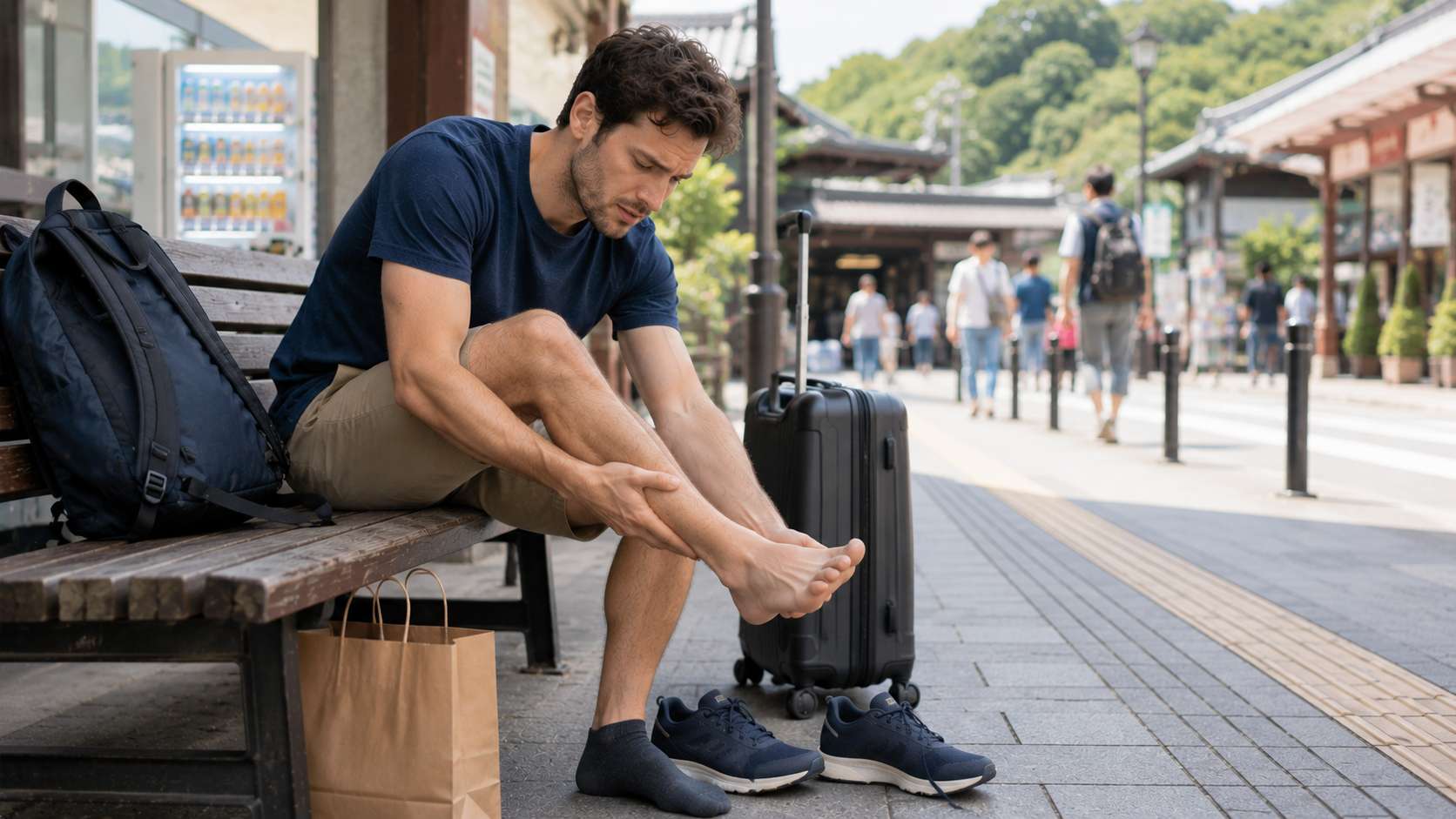
Foot pain, shoe rubbing, and blisters are very common during travel in Japan. Many visitors walk much more than usual, stand in lines, use stairs, carry luggage, or wear shoes that are not ideal for long sightseeing days.
Japanese drugstores usually sell bandages, blister pads, dressings, antiseptic products, foot-care items, and some OTC pain-relief products. This guide explains what to check before using them. It does not recommend a specific product. Product labels and package instructions matter, and each product has its own warnings and limits. If you are not sure what to use, ask a pharmacist or registered seller.
Quick Guide: What Should You Check First?
| Situation | What to check first |
| Your shoe is rubbing but the skin is not broken | A protective pad, blister prevention pad, or bandage may help reduce friction. |
| You have a closed blister | Keep it clean and protected. Do not pop it yourself. A blister pad or soft dressing may help. |
| The blister has burst | Wash your hands, keep it clean, let fluid drain naturally, and cover it with a clean dressing. Do not peel off the skin. |
| You have a small cut or scrape from shoes | Clean the area and cover it with a sterile dressing or bandage. Ask pharmacy staff if antiseptic is needed. |
| The area is red, hot, swollen, painful, has pus, or you have fever | Consider medical care. These may be signs of infection. |
| You have diabetes, poor circulation, immune suppression, or loss of feeling in the feet | Do not treat foot wounds casually. Consider medical care early. |
In short: protect the skin, reduce friction, keep the area clean, and watch for infection. A simple blister may heal on its own, but infected or high-risk foot wounds need medical attention.
What You Can Buy at Japanese Drugstores
Japanese drugstores may sell several types of foot-care and wound-care products.
Regular bandages and adhesive plasters
Regular bandages or adhesive plasters can protect small areas of rubbing, minor cuts, or small scrapes. They may help keep the area clean and reduce friction from shoes.
Check:
- whether the pad covers the whole affected area
- whether it sticks well inside shoes
- whether it is waterproof
- how often to change it
- whether your skin reacts to the adhesive
If the bandage becomes wet, dirty, or loose, change it.
Blister pads and hydrocolloid dressings
Blister pads and hydrocolloid-type dressings are often used to protect closed blisters or shoe-rubbing areas. They may reduce pain by cushioning the blister and protecting it from more friction.
Check the package carefully. Some products are meant for closed blisters, while others may have different instructions for broken skin. Do not use a product on an infected-looking blister unless pharmacy staff or a healthcare professional says it is appropriate.
Antiseptic products
For small cuts or scrapes, you may see antiseptic-related ingredients such as:
- benzalkonium chloride
- povidone-iodine
- chlorhexidine gluconate
- ethanol or alcohol-based disinfectants
These names are label clues, not recommendations. Not every blister needs antiseptic, and some antiseptics may sting or irritate broken skin. For a clean, closed blister, protection from friction may be more important than disinfecting it repeatedly. If the skin is broken, dirty, or at risk of infection, ask pharmacy staff what is appropriate.
Ointments or creams for irritated skin
Some products are used for minor skin irritation, rubbing, or small wounds, depending on the product. Check whether the product is for intact skin, broken skin, cuts, burns, eczema, or infection-related symptoms.
Do not apply random creams to an open blister or cut. If there is pus, spreading redness, strong pain, or warmth, medical care may be better than another OTC product.
Pain-relief patches, gels, or sprays
If the problem feels like deeper muscle, joint, ankle, or knee pain rather than a skin blister, a topical pain-relief product may be considered. However, do not apply pain-relief patches, gels, or sprays directly on broken skin, blisters, cuts, eczema, or infected-looking skin.
For deeper muscle or joint pain, see our guide: Muscle Pain and Joint Pain Medicine in Japan: Patches, Gels, and Pain Relief.
Corn and callus products
If your foot pain is from a hard thickened area, corn, or callus, you may see products that contain keratolytic ingredients such as salicylic acid. These products are not for ordinary blisters.
Do not use corn or callus remover products on:
- blisters
- open wounds
- bleeding skin
- infected-looking skin
- irritated or inflamed skin
- diabetic foot problems or poor circulation unless a healthcare professional says it is safe
If you are not sure whether it is a corn, callus, wart, blister, or infection, ask pharmacy staff or consider medical care.
Should You Pop a Blister?
In general, do not pop a blister yourself. The skin over the blister helps protect the area underneath. Popping it can increase the risk of infection and slow healing.
If a blister has already burst:
- wash your hands before touching it
- gently clean the area
- let the fluid drain naturally
- do not peel off the remaining skin
- cover it with a clean dressing or bandage
- change the dressing if it becomes wet or dirty
If the blister is very large, very painful, infected-looking, or keeps coming back, medical care may be safer than trying to drain it yourself.
When Foot Pain or Blisters May Need Medical Care
Consider medical care instead of relying on drugstore products if you have:
- spreading redness, warmth, swelling, or worsening pain
- yellow or green pus
- fever or feeling very unwell
- red streaks spreading from the wound
- a blister caused by a burn, sunburn, chemical exposure, or allergic reaction
- several blisters for no clear reason
- a wound that is deep, dirty, or has something stuck in it
- bleeding that does not stop with pressure
- trouble walking or putting weight on the foot
- numbness, loss of feeling, or severe pain
- diabetes, poor circulation, immune suppression, or a foot wound that is not healing
If the situation feels severe or urgent, ask nearby staff for help or call 119 in Japan.
If you are not sure how to find medical care in Japan, see our guide: How to See a Doctor in Japan as a Traveler.
Simple Prevention Tips During Travel
To reduce foot pain and blisters during travel:
- wear comfortable shoes that are already broken in
- use thicker or moisture-wicking socks if your feet sweat
- change socks if they become wet
- reduce friction with protective pads before a blister forms
- take breaks during long sightseeing days
- avoid walking long distances in new shoes
- keep a few bandages or blister pads in your bag
If you feel rubbing early, stop and protect the area before a blister becomes large.
How to Ask at a Japanese Pharmacy
You can show these phrases to pharmacy staff.
| What you mean | Japanese to show |
| My shoes rubbed my foot and I have a blister. | 靴ずれで水ぶくれができました。 |
| My foot hurts from walking. | 歩きすぎて足が痛いです。 |
| I am looking for a blister pad or protective bandage. | 水ぶくれ用のパッドや保護用の絆創膏を探しています。 |
| The blister has burst. | 水ぶくれが破れています。 |
| The area is red and painful. | 赤くなって痛みがあります。 |
| There is pus or it looks infected. | 膿が出ている、または感染しているように見えます。 |
| I have diabetes / poor circulation. | 糖尿病/血流が悪い持病があります。 |
| Can I use this product on broken skin? | 皮膚が破れている場所にこの製品を使えますか? |
| Please tell me whether I should see a doctor. | 受診した方がよい症状か教えてください。 |
For a broader pharmacy communication card, see: Show This at a Japanese Pharmacy: OTC Medicine Questions in English and Japanese.
Related Guides
You may also want to read:
- Muscle Pain and Joint Pain Medicine in Japan: Patches, Gels, and Pain Relief
- Skin Rash and Itching Medicine in Japan: OTC Creams and Safety Checks
- Insect Bite and Itching Medicine in Japan: OTC Creams and Safety Checks
- Drugstore Basics in Japan: How to Buy OTC Medicine Safely
- How to See a Doctor in Japan as a Traveler
References
- NHS. Blisters. https://www.nhs.uk/conditions/blisters/
- NHS. Cuts and grazes. https://www.nhs.uk/conditions/cuts-and-grazes/
- Pharmaceuticals and Medical Devices Agency (PMDA). OTC medicine and package insert search. https://www.pmda.go.jp/PmdaSearch/otcSearch/
—