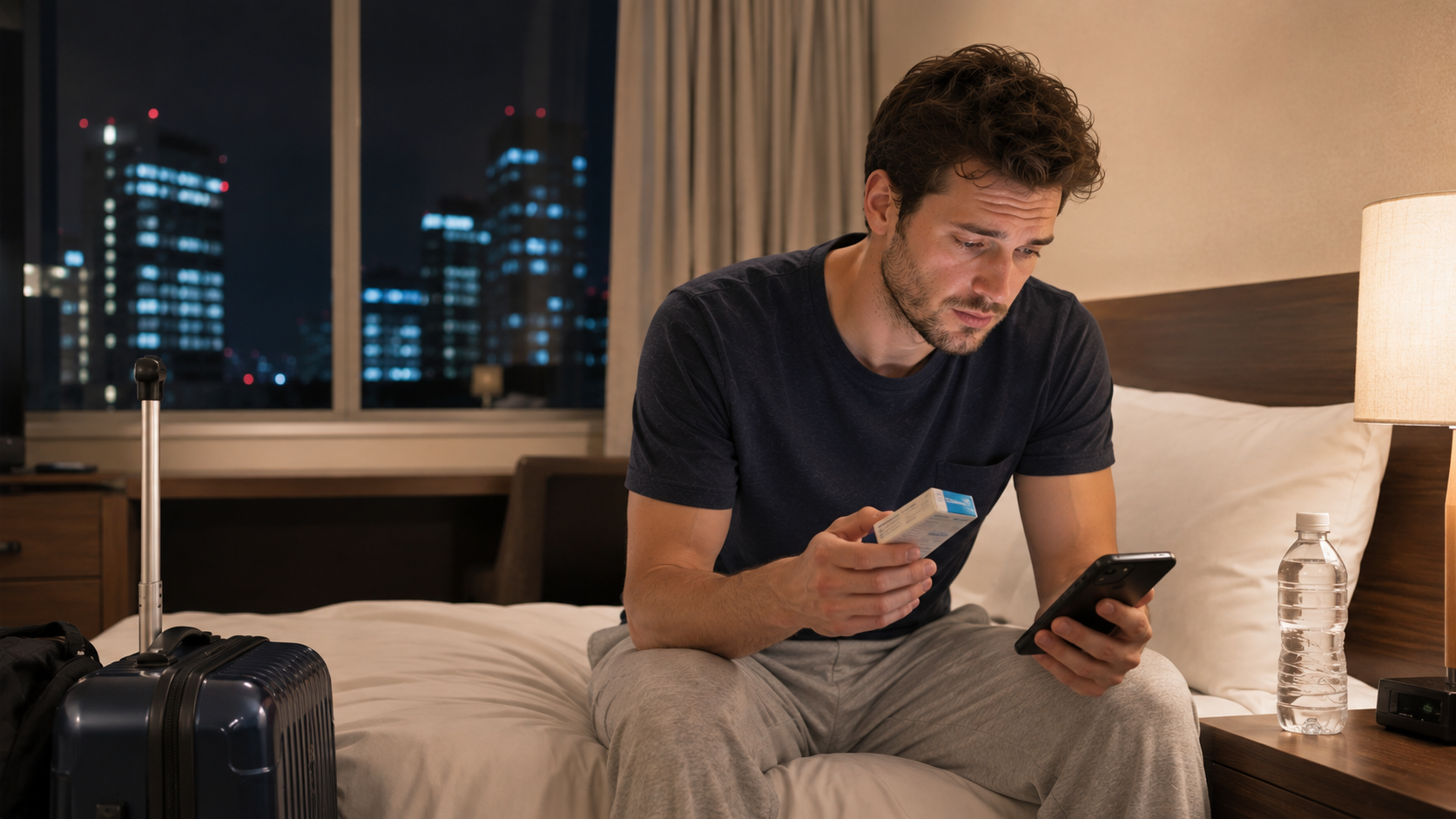
Trouble sleeping can happen during travel. Jet lag, schedule changes, hotel noise, stress, or early sightseeing plans can make it hard to fall asleep. Japanese drugstores may sell OTC sleep aids, but they are not the same as prescription sleeping pills, and they are not meant for long-term or diagnosed insomnia.
Before using any OTC sleep aid in Japan, read the label and package insert, especially the section that explains who should not use the medicine. Each product has its own warnings and contraindications. If you are not sure, ask a pharmacist or registered seller before buying or taking it.
This guide explains what to check before using OTC sleep aids in Japan. It does not recommend a specific product.
- Quick Takeaway: Check This First
- OTC Sleep Aids Are for Temporary Sleep Trouble
- Ingredient Name You May See: Diphenhydramine Hydrochloride
- Check the “Do Not Use” Section Before Taking It
- Ask Pharmacy Staff First in These Situations
- Be Careful About Next-Day Sleepiness
- When Not to Rely on OTC Sleep Aids
- Useful Phrases to Show at a Japanese Pharmacy
- Related Guides
- References
Quick Takeaway: Check This First
| What to check | Why it matters |
| Is this for temporary sleeplessness only? | Many OTC sleep aids are intended for temporary trouble sleeping, not chronic insomnia. |
| What is the active ingredient? | Diphenhydramine hydrochloride is one ingredient you may see in Japanese OTC sleep-improvement medicine. |
| Does the label say “do not use” for your situation? | Age, pregnancy, diagnosed insomnia, other medicines, and medical conditions can matter. |
| Are you already taking cold, allergy, motion sickness, cough, or pain medicine? | Some products can overlap with antihistamine or sedating ingredients. |
| Do you need to drive, cycle, work, or stay alert the next day? | Sleepiness, dullness, or reduced alertness may continue after waking. |
| Are sleep problems continuing for many days? | Ongoing or severe sleep problems should not be managed only with OTC sleep aids. |
In short: check the “do not use” section first, and ask pharmacy staff whether the medicine is appropriate for you.
OTC Sleep Aids Are for Temporary Sleep Trouble
Some OTC sleep-improvement medicines in Japan are used for temporary sleeplessness, such as:
- difficulty falling asleep
- shallow sleep
- temporary sleep disruption during travel
They are not a treatment for chronic insomnia, diagnosed insomnia, severe anxiety, depression, sleep apnea, or ongoing sleep problems. If you have trouble sleeping for many nights, or if sleep problems are affecting your daily life, consider medical care instead of repeating OTC sleep aids.
Ingredient Name You May See: Diphenhydramine Hydrochloride
One active ingredient you may see on Japanese OTC sleep aid labels is:
- diphenhydramine hydrochloride
In Japanese, this may appear as:
- ジフェンヒドラミン塩酸塩
This ingredient is an antihistamine-type ingredient. In sleep-improvement medicine, its drowsiness effect is used for temporary sleeplessness. However, antihistamine-type ingredients may also appear in other OTC medicines, including some cold medicines, allergy medicines, nasal medicines, cough medicines, and motion sickness medicines.
Do not choose a product only because you see this ingredient name. Use it as a label clue, then check the age limit, dose, timing, warnings, and whether it can be used with your other medicines.
Check the “Do Not Use” Section Before Taking It
Before taking an OTC sleep aid, check the label or package insert for “do not use” instructions. Examples of situations that may be listed for diphenhydramine sleep-improvement products include:
- children under 15 years old
- pregnancy or possible pregnancy
- people who have been diagnosed with insomnia
- people who have daily or long-term insomnia
- use together with other sleep aids or sedatives
- use together with cold medicine, fever or pain medicine, cough or phlegm medicine, nasal allergy medicine, motion sickness medicine, allergy medicine, or other medicines that contain antihistamine-type ingredients
- drinking alcohol before or after taking the medicine
- driving, cycling, operating machinery, or doing tasks that require clear alertness after taking the medicine
The exact warning list differs by product. If you cannot read the Japanese label, ask a pharmacist or registered seller to check it with you.
Ask Pharmacy Staff First in These Situations
Ask pharmacy staff before using an OTC sleep aid if:
- the medicine is for an elderly person
- you are pregnant, may be pregnant, or breastfeeding
- you have glaucoma
- you have prostate enlargement or difficulty urinating
- you have a chronic condition
- you take prescription medicine or other OTC medicine
- you already used alcohol, sedatives, allergy medicine, cold medicine, or motion sickness medicine
- you need to drive or stay alert the next day
Even if a medicine is sold at a drugstore, it may not be suitable for every person.
Be Careful About Next-Day Sleepiness
OTC sleep aids can cause drowsiness, dullness, reduced concentration, dry mouth, blurred vision, or difficulty urinating. Some people may still feel sleepy or slow the next morning.
If you need to drive, cycle, travel early, guide children, climb stairs, use public transportation alone, drink alcohol, or make important decisions the next day, be cautious. Ask pharmacy staff whether the product is appropriate for your plan.
When Not to Rely on OTC Sleep Aids
Do not rely only on OTC sleep aids if you have:
- trouble sleeping for many days
- severe anxiety, depression, panic, confusion, or unusual behavior
- chest pain, breathing problems, severe pain, or high fever
- loud snoring with pauses in breathing or suspected sleep apnea
- repeated daytime sleepiness that affects daily activities
- sleep problems that may be related to alcohol, medication, or substance use
If you are not sure how to find medical care in Japan, see our guide: How to See a Doctor in Japan as a Traveler.
Useful Phrases to Show at a Japanese Pharmacy
| What you mean | Japanese to show |
| I am looking for an OTC sleep aid for temporary trouble sleeping. | 一時的に眠りにくいときに使う市販の睡眠改善薬を探しています。 |
| Does this medicine contain diphenhydramine? | この薬はジフェンヒドラミンを含んでいますか? |
| Please check the “do not use” section for me. | 「してはいけないこと」の欄を確認してもらえますか? |
| Can I use this with my cold, allergy, or motion sickness medicine? | 風邪薬、アレルギーの薬、乗り物酔いの薬と一緒に使えますか? |
| I may need to drive or stay alert tomorrow. Is this suitable for me? | 明日、運転したり注意力が必要な予定があります。私に使えますか? |
| I am pregnant or breastfeeding. Can I use this? | 妊娠中、または授乳中です。使えますか? |
| I have glaucoma or difficulty urinating. Can I use this? | 緑内障、または排尿しにくい症状があります。使えますか? |
| I have had trouble sleeping for many days. Should I see a doctor? | 何日も眠れない状態が続いています。受診した方がよいですか? |
Related Guides
You may also want to read:
- Drugstore Basics in Japan: How to Buy OTC Medicine Safely
- Cold Medicine in Japan: What to Check Before Buying OTC Medicine
- Runny Nose and Allergy Medicine in Japan
- Motion Sickness Medicine in Japan
- How to See a Doctor in Japan as a Traveler
References
- Pharmaceuticals and Medical Devices Agency (PMDA). OTC medicine package insert search.
- SSP Co., Ltd. Drewell product information.