Japanese drugstores have many stomach medicines. For heartburn, acid reflux, sour stomach, stomach heaviness, or “mukamuka,” first check the medicine type, not the product name.
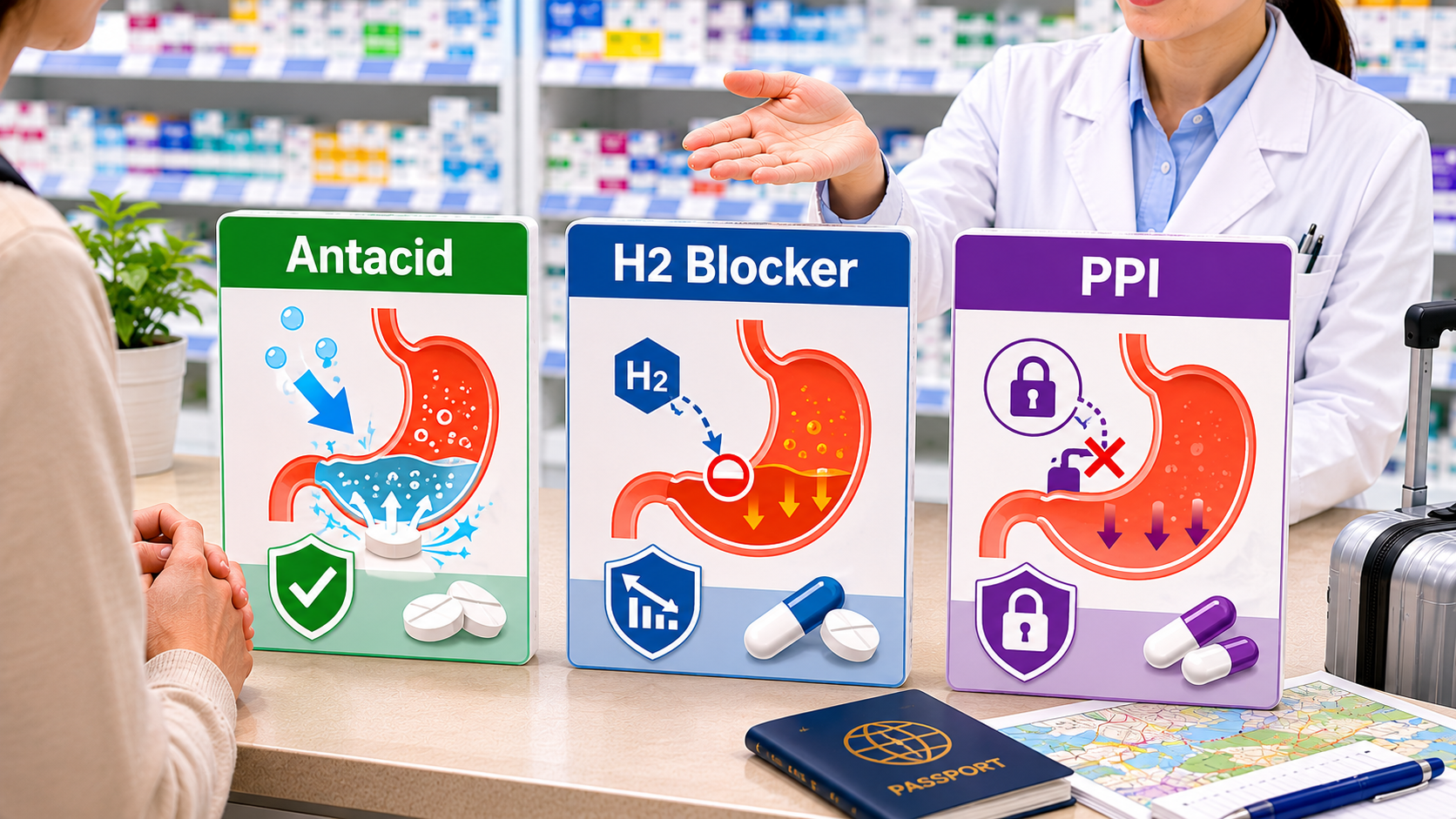
| Type | What it does | Ingredient clues in Japan | What to check |
| Antacid | Neutralizes stomach acid already present | magnesium, aluminum, calcium, sodium bicarbonate-type ingredients | Often for short-term acid discomfort. Check the full label because many Japanese stomach medicines are combination products. |
| H2 blocker | Reduces stomach acid secretion | famotidine / ファモチジン | OTC famotidine products are Class 1 OTC medicines, so pharmacist involvement is required. |
| PPI | Reduces acid secretion at the final acid pump | lansoprazole, omeprazole, rabeprazole sodium | Current non-prescription PPI products in Japan are guidance-required medicines. A pharmacist must confirm whether they are appropriate. |
In general, PPIs suppress stomach acid more strongly than H2 blockers. But stronger does not mean “best for every stomach problem.” These three types work differently and have different purchase checks in Japan.
This article is general information for travelers and residents in Japan. It is not a diagnosis or a personal medicine recommendation.
Quick Rule
- Antacid = acid is already there, so the medicine neutralizes it.
- H2 blocker = the stomach makes less acid; famotidine is the key OTC clue.
- PPI = usually stronger acid suppression than H2 blockers, but pharmacist confirmation is needed in Japan.
Do not combine antacids, famotidine, PPIs, or several stomach medicines on your own. Ask pharmacy staff which type fits your symptoms.
Antacids
Antacids may include:
- synthetic hydrotalcite
- magnesium aluminometasilicate
- dried aluminum hydroxide gel
- magnesium oxide or magnesium hydroxide
- calcium carbonate
- sodium bicarbonate
They may be used for short-term acid discomfort, but the full product matters. Many Japanese stomach medicines also contain digestive enzymes, herbal ingredients, or mucosal protectants.
Ask pharmacy staff before use if you have kidney disease, heart disease, high blood pressure, pregnancy, breastfeeding, regular medicines, or mineral/sodium restrictions.
H2 Blockers
The main OTC H2 blocker ingredient to recognize in Japan is:
- famotidine
- ファモチジン
Famotidine is not an antacid. It reduces acid secretion rather than neutralizing acid already in the stomach.
In Japan, OTC famotidine products are Class 1 OTC medicines (第1類医薬品). A pharmacist must be involved in the sale, so availability depends on the pharmacist counter.
PPIs
PPI stands for proton pump inhibitor. PPIs reduce acid secretion by blocking the final acid pump in the stomach.
Current non-prescription PPI products in Japan may include:
- lansoprazole / ランソプラゾール
- omeprazole / オメプラゾール
- rabeprazole sodium / ラベプラゾールナトリウム
PPIs generally suppress stomach acid more strongly than H2 blockers, but they are not general “strong stomach medicine” for any stomach symptom.
Current non-prescription PPI products in Japan are guidance-required medicines (要指導医薬品). A pharmacist must check whether the product is appropriate and explain how to use it. Follow the product label for age limits, dosing, and maximum self-use period.
If your main symptom is unexplained nausea, repeated vomiting, diarrhea, motion sickness, severe abdominal pain, or a new unusual symptom, tell pharmacy staff instead of assuming you need a PPI.
Symptom Words
| Word | Practical meaning |
| Heartburn / 胸やけ | Burning feeling in the chest or upper stomach. Chest pain can also be serious, so describe it clearly. |
| Acid reflux / 胃酸逆流 | Acid or stomach contents coming up. Mention sour or bitter taste. |
| Stomach heaviness / 胃もたれ | Heavy or full feeling, often after meals. Not always acid reflux. |
| Mukamuka / むかむか | Queasy or nauseous feeling. Not always acid-related. |
If you mainly have burning, acid coming up, or sour/bitter taste, see: Heartburn Medicine in Japan: OTC Ingredients for Acid Reflux, Sour Stomach, and Mukamuka.
If you have broader digestive symptoms such as diarrhea, constipation, cramps, or repeated vomiting, start with: Stomach and Digestive Problems in Japan: OTC Medicine Ingredients and Safety Checks.
Before You Buy
Check:
- Active ingredient names
- Medicine type: antacid, H2 blocker, PPI, or combination product
- Age limit
- Dose and maximum daily use
- How long you can self-treat
- Pregnancy, breastfeeding, kidney, liver, heart, or stomach ulcer warnings
- Other medicines already taken
- “Things you must not do” and “when to consult” sections
For Japanese OTC medicine categories, see: Drugstore Basics in Japan: How to Buy OTC Medicine Safely.
Pharmacy Phrases
| English meaning | Japanese to show |
| I have heartburn. | 胸やけがあります。 |
| I feel acid coming up. | 胃酸が上がってくる感じがあります。 |
| My stomach feels heavy after meals. | 食後に胃もたれがあります。 |
| I feel mukamuka / nauseous. | 胃がむかむかします。吐き気に近い感じです。 |
| Is this an antacid, H2 blocker, or PPI? | これは制酸薬、H2ブロッカー、PPIのどれですか? |
| Does this contain famotidine? | これはファモチジンを含んでいますか? |
| Does this contain a PPI? | これはPPIを含んでいますか? |
| Can I use this with my other medicines? | ほかに飲んでいる薬と一緒に使えますか? |
| Should I see a doctor instead? | 市販薬ではなく、受診した方がよいですか? |
For a broader phrase card, see: Show This at a Japanese Pharmacy: OTC Medicine Questions in English and Japanese.
When to Seek Medical Care
Do not rely only on OTC stomach medicine if symptoms are severe, unusual, worsening, or not improving within the package’s recommended time.
Seek medical care promptly for:
- strong chest pain, chest pressure, shortness of breath, cold sweat, faintness, or pain spreading to the arm, shoulder, back, jaw, or neck
- black stool, blood in the stool, vomiting blood, or vomit that looks like coffee grounds
- trouble swallowing or pain when swallowing
- unexplained weight loss or loss of appetite
- persistent or repeated vomiting
- severe, sudden, or worsening abdominal pain
- symptoms that keep returning or last longer than the label says to self-treat
Chest pain is not always heartburn. If symptoms feel severe or urgent in Japan, call 119.
If it is not an ambulance situation but you are unsure how to find care, see: How to See a Doctor in Japan as a Traveler.
Bottom Line
For acid-related stomach medicine in Japan:
- Antacid = neutralizes acid already present.
- Famotidine = H2 blocker clue.
- PPI = stronger acid suppression category, but pharmacist confirmation is required in Japan.
If warning signs are present, or if the symptom is not clearly acid-related, ask pharmacy staff or seek medical care instead of moving to a stronger stomach medicine.
Related Guides
- Heartburn Medicine in Japan: OTC Ingredients for Acid Reflux, Sour Stomach, and Mukamuka
- Stomach and Digestive Problems in Japan: OTC Medicine Ingredients and Safety Checks
- Drugstore Basics in Japan: How to Buy OTC Medicine Safely
- Show This at a Japanese Pharmacy: OTC Medicine Questions in English and Japanese
- How to See a Doctor in Japan as a Traveler
References
- Ministry of Health, Labour and Welfare. Information on Japan’s OTC medicine sales system. https://www.mhlw.go.jp/stf/seisakunitsuite/bunya/0000082514.html
- Pharmaceuticals and Medical Devices Agency (PMDA). OTC and guidance-required medicine package insert search. https://www.pmda.go.jp/PmdaSearch/otcSearch/
- Daiichi Sankyo Healthcare. Official Gaster 10 product information and package insert. https://www.daiichisankyo-hc.co.jp/products/details/gaster/
- Alinamin Pharmaceutical. Official Takepron S product information. https://alinamin-kenko.jp/products/gastrointestinal/takepron-s.html
- Sato Pharmaceutical. Official Omepral S product information. https://www.sato-seiyaku.co.jp/omeprals/product/
- Eisai. Official Pariet S product information and package insert. https://www.eisai.jp/products/pariet/pariets
- National Institute of Diabetes and Digestive and Kidney Diseases. Symptoms and causes of GER and GERD. https://www.niddk.nih.gov/health-information/digestive-diseases/acid-reflux-ger-gerd-adults/symptoms-causes
- National Institute of Diabetes and Digestive and Kidney Diseases. Treatment for GER and GERD. https://www.niddk.nih.gov/health-information/digestive-diseases/acid-reflux-ger-gerd-adults/treatment
- National Heart, Lung, and Blood Institute. Heart attack symptoms. https://www.nhlbi.nih.gov/health/heart-attack/symptoms