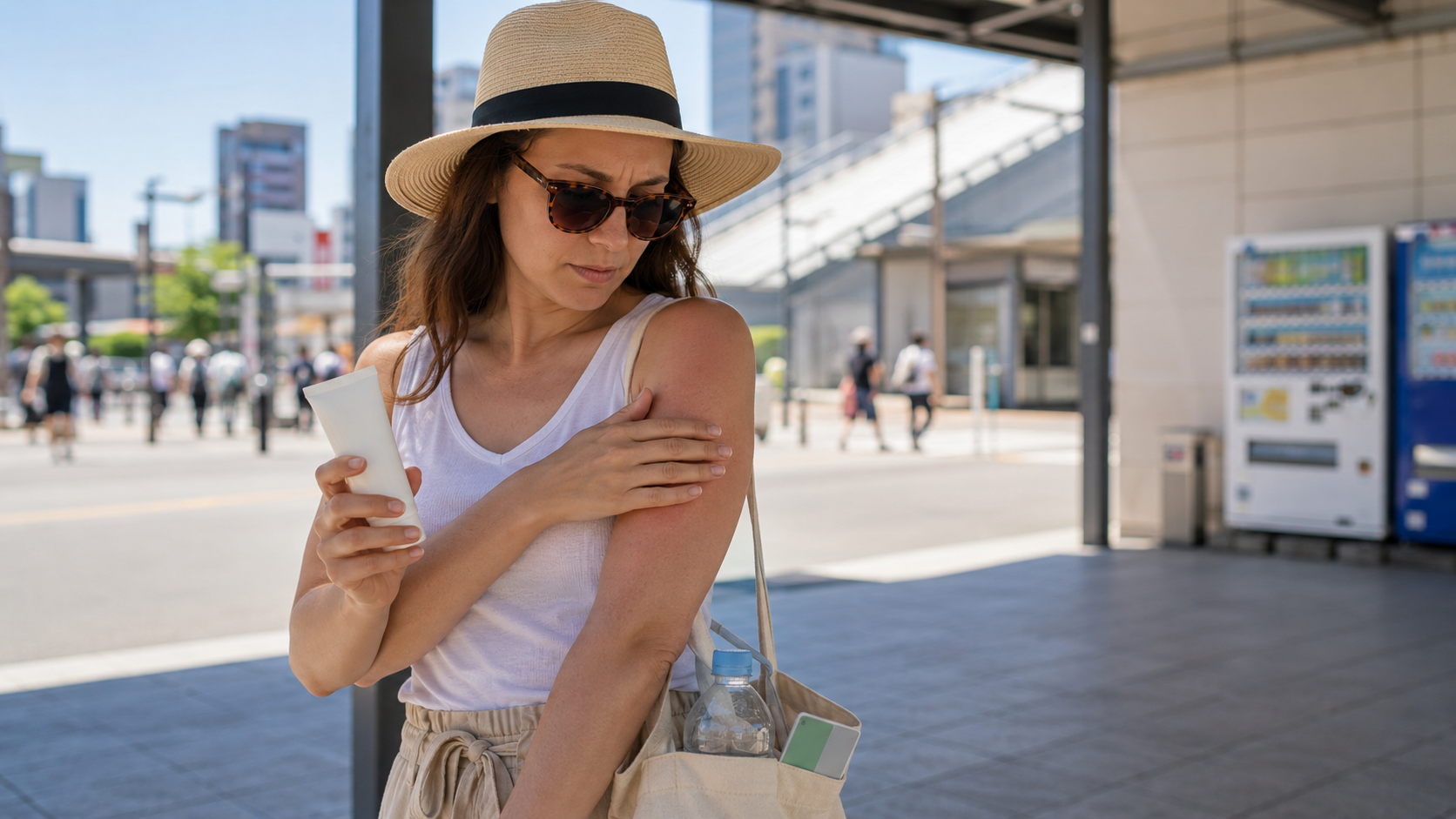
If you are buying sunscreen in Japan, the quick answer is:
Check SPF, PA, UV water resistance, and the product type. For strong summer sun, beach, pool, hiking, or long sightseeing days, many travelers look for SPF50+ / PA++++ and reapply often.
In Japan, sunscreen is usually a cosmetic product, not a medicine. You may see lightweight gels, milks, creams, sprays, sticks, and makeup-base sunscreens.
The best sunscreen is not just the highest number. It is the one you can apply enough of, reapply, and tolerate on your skin.
Quick Label Guide
| Label | What it means | Traveler tip |
|---|---|---|
| SPF | Mainly UVB protection, related to red sunburn | Higher numbers matter for strong sun, but enough product and reapplication still matter |
| PA+ to PA++++ | UVA protection | More plus signs mean stronger UVA protection; PA++++ is the highest common Japanese label |
| SPF50+ | SPF is above 50 on Japan-style labeling | Common for Japanese summer, beach, pool, hiking, and long outdoor days |
| UV耐水性★ / ★★ | UV water resistance display | Useful for water exposure; ★★ is stronger than ★ |
| ウォータープルーフ | Waterproof-style claim | Still check UV耐水性 and reapply after water, sweat, or towel drying |
| 石けんで落とせる | Can be washed off with soap | Convenient for daily sightseeing; may not be the best for heavy water exposure |
| 紫外線吸収剤不使用 | No UV absorbers | Often chosen by people who want a mineral-filter style product |
SPF and PA: The Main Two Labels
SPF is mainly about protection from UVB, the type of ultraviolet ray closely linked with red sunburn.
PA is about protection from UVA. In Japan, PA is shown with plus signs:
- PA+
- PA++
- PA+++
- PA++++
More plus signs mean stronger UVA protection. If you are in Japan during summer or spending a long time outdoors, PA++++ is easy to look for.
What Is UV Water Resistance?
Japan also uses a newer label: UV耐水性, meaning UV water resistance.
You may see:
- UV耐水性★
- UV耐水性★★
This label is about how well UV protection is maintained after water exposure. It does not mean the sunscreen is stronger than another product with the same SPF and PA. It also does not mean you never need to reapply.
Choose UV water resistance if you will be at the beach, pool, river, water park, boat activity, or other wet setting. For strong water exposure, UV耐水性★★ is the easier label to look for.
Which Type Should Travelers Choose?
| Type | May suit someone who… | Quick note |
|---|---|---|
| Gel / essence | wants a light, less sticky daily sunscreen | Popular in Japan; nice for city sightseeing |
| Milk / lotion | wants a common face-and-body option | Often a balanced choice for outdoor use |
| Cream | has dry skin or wants a richer face product | Can feel heavier but may be comfortable for dry skin |
| Spray | wants touch-up help for body, hairline, or hard-to-reach areas | Avoid inhaling; do not spray directly on the face |
| Stick | wants quick reapplication on nose, cheeks, ears, or hands | Good for a day bag, but cover evenly |
| Makeup base / tone-up | wants sunscreen under makeup | Check whether it is face-only or face/body |
For a long summer sightseeing day, a practical combination is:
a lotion or milk for the first full application, plus a stick or spray for touch-ups.
Japanese Words to Look For
| Japanese | Romaji | Meaning |
|---|---|---|
| 日焼け止め | hiyakedome | sunscreen |
| 紫外線 | shigaisen | ultraviolet rays |
| 顔・からだ用 | kao / karada yo | for face and body |
| 敏感肌 | binkan hada | sensitive skin |
| 子ども用 | kodomo yo | for children |
| 石けんで落とせる | sekken de otoseru | washable with soap |
| 化粧下地 | kesho shitaji | makeup base |
| 無香料 | mukoryo | fragrance-free |
| ノンケミカル | non-chemical | often used for no UV absorber / mineral-filter style products |
How to Use Sunscreen During Japan Travel
Sunscreen works best when you use enough and reapply.
Practical travel checks:
- Apply before going outside.
- Cover easy-to-miss areas: ears, neck, back of hands, tops of feet, hairline, and shoulders.
- Reapply every 2 to 3 hours, and sooner after swimming, sweating, or towel drying.
- Use shade, a hat, sunglasses, UV umbrella, and light long sleeves when possible.
- Check the Japan Meteorological Agency UV Index if you want a local UV forecast.
In hot Japanese summer weather, sun protection and heat illness prevention go together. Sunscreen does not prevent heat illness by itself.
For heat-related symptoms, see: Heat Illness in Japan: What Travelers Should Check Before Taking Fever Medicine
If You Already Got Sunburned
For mild sunburn:
- get out of direct sun
- cool the skin with cool water or a damp towel
- drink fluids
- avoid scratching or peeling the skin
- ask pharmacy staff about moisturizer, aloe gel, or pain relief if needed
Seek medical care if there are large blisters, fever, chills, severe pain, dizziness, confusion, eye pain, vomiting, severe dehydration, or possible heat illness.
For where to go, see: Where Should I Go If I Feel Sick in Japan?
Quick Pharmacy Phrases
| English meaning | Japanese to show |
|---|---|
| I am looking for sunscreen. | 日焼け止めを探しています。 |
| I burn easily. | 日焼けしやすいです。 |
| I want SPF50+ and PA++++. | SPF50+、PA++++のものが欲しいです。 |
| I need something for face and body. | 顔とからだに使えるものが欲しいです。 |
| I want something for sensitive skin. | 敏感肌向けのものが欲しいです。 |
| I will go to the beach / pool. | 海 / プールに行きます。 |
| Is this water resistant? | これは水に強いですか? |
| Can this be removed with soap? | これは石けんで落とせますか? |
| I got sunburned. What should I use? | 日焼けしてしまいました。何を使えばよいですか? |
For general shopping help, see: Drugstore Basics in Japan
Bottom Line
When buying sunscreen in Japan:
- SPF = mainly UVB / red sunburn protection.
- PA = UVA protection; PA++++ is the highest common label.
- UV耐水性★/★★ = useful for water exposure, not a reason to skip reapplying.
- Gel, milk, cream, spray, stick = choose by texture and how you will actually use it.
- Sunscreen helps, but shade, hats, sunglasses, clothing, fluids, and breaks matter too.
Related Guides
- Heat Illness in Japan: What Travelers Should Check Before Taking Fever Medicine
- Which Oral Rehydration Product Should I Buy in Japan?
- Drugstore Basics in Japan
- Where Should I Go If I Feel Sick in Japan?
References
- Japan Cosmetic Industry Association. UV terminology: SPF, PA, and UV water resistance. https://www.jcia.org/user/public/uv/glossary
- Japan Cosmetic Industry Association. Basic sun protection. https://www.jcia.org/user/public/uv/prevent
- Japan Cosmetic Industry Association. UV water resistance Q&A. https://www.jcia.org/user/public/uv/faq
- Japan Meteorological Agency. UV Index. https://www.data.jma.go.jp/env/uvindex/en/index.html
- Japan Meteorological Agency. About the UV Index. https://www.jma.go.jp/jma/kishou/know/env/uvhp/3-50uvindex_manual.html
- MedlinePlus. Sunburn. https://medlineplus.gov/ency/article/003227.htm
- American Academy of Dermatology. How to use stick and spray sunscreens. https://www.aad.org/public/everyday-care/sun-protection/shade-clothing-sunscreen/how-to-use-stick-spray-sunscreens