If you are a traveler thinking about seeing a doctor in Japan, the quick answer is:
Do not assume Japanese health insurance applies to you. Short-term visitors may need to pay the full medical cost themselves, and medicine may be charged separately at a pharmacy. If you have travel insurance, contact your assistance line early, ask the clinic or hospital about payment methods, and keep all receipts and documents.
This guide is for ordinary travel situations. If it is an emergency, call 119 in Japan.
Quick Checklist Before You Go
Before visiting a clinic or hospital, check:
| What to check | Why it matters |
|---|---|
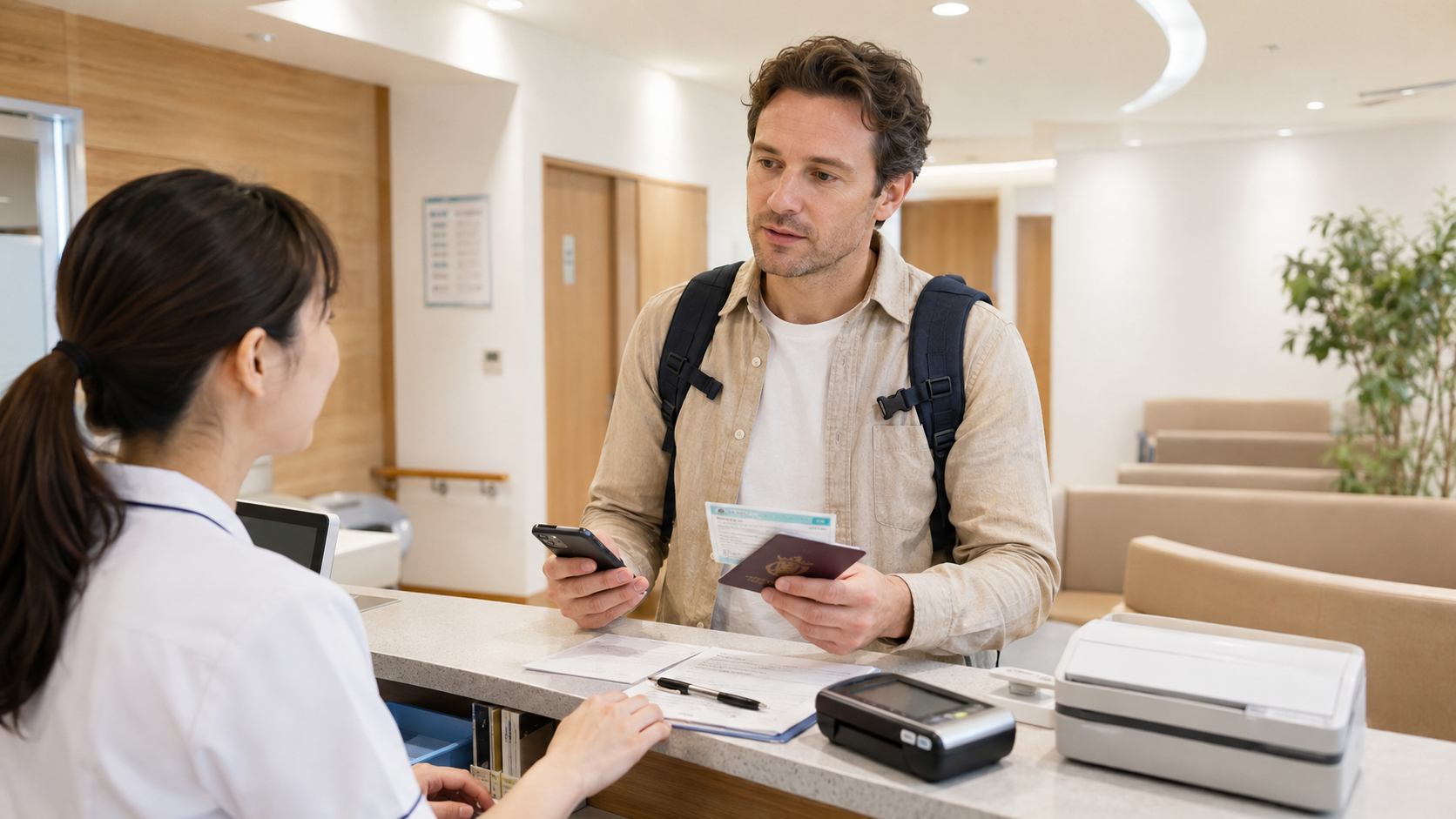
| Travel insurance assistance line | They may help find a medical facility, explain cashless options, or tell you what documents you need |
| Payment method | Some clinics may prefer or require cash; larger hospitals may be more likely to accept cards |
| Estimated cost | Ask for a rough estimate at reception when possible |
| Language support | English support varies by facility and timing |
| Documents | Bring passport, insurance details, medicine list, allergy list, and any medical records you have |
Why Medical Costs Can Surprise Travelers
Medical costs in Japan can be split into several parts:
- consultation or examination
- tests, imaging, procedures, or treatment
- prescription medicine
- pharmacy payment
- hospital admission or surgery if needed
- documents for insurance claims
JNTO’s medical guide notes that medicine may be paid for separately at a pharmacy, and that payment methods vary by facility. It also notes that travelers without overseas travel insurance may be charged the full amount.
So even for a non-emergency visit, it is smart to ask about payment before treatment starts when the situation allows.
Travel Insurance: Cashless Does Not Always Mean Automatic
Some travel insurance plans include a cashless payment service. This may allow the bill to be handled between the medical facility and the insurance or assistance company.
But this is not automatic for every clinic, hospital, symptom, or insurance plan.
Before you go, ask your insurer:
- Which clinic or hospital should I use?
- Do I need pre-approval?
- Is cashless payment possible here?
- What documents do I need for a claim?
- Are prescription medicines covered?
If you already paid, ask what receipts and documents you need for reimbursement.
What to Keep After the Visit
Keep these until your insurance claim is finished:
- clinic or hospital receipt
- medical fee statement or itemized bill
- diagnosis or treatment note if available
- prescription
- pharmacy receipt
- medicine information sheet
- credit card slip if you paid by card
Take photos or scans as a backup, but keep the originals if your insurer requires them.
Helpful Japanese Phrases
| English meaning | Japanese to show |
|---|---|
| I am a traveler and do not have Japanese health insurance. | 旅行者で、日本の健康保険はありません。 |
| I have travel insurance. | 海外旅行保険に入っています。 |
| Can I pay by credit card? | クレジットカードで支払えますか? |
| Do I need to pay in cash? | 現金で支払う必要がありますか? |
| Can I get a receipt for my insurance claim? | 保険請求用の領収書をもらえますか? |
| Can I get an itemized medical bill? | 診療明細書をもらえますか? |
| Is the medicine paid separately at a pharmacy? | 薬代は薬局で別に支払いますか? |
When It Is an Emergency
Do not delay emergency care because of cost concerns.
Call 119 in Japan if someone has trouble breathing, chest pain, severe injury, loss of consciousness, seizure, severe allergic reaction, stroke-like symptoms, or appears seriously ill.
For help choosing where to go when it is not clearly an emergency, see: Where Should I Go If I Feel Sick in Japan?
For general medical visit steps, see: How to See a Doctor in Japan as a Traveler
Bottom Line
Before seeing a doctor in Japan as a traveler:
- Contact your travel insurance assistance line if you have one.
- Ask the clinic or hospital about payment methods and rough costs.
- Bring passport, insurance details, medicine list, and allergy list.
- Keep all receipts, prescriptions, and pharmacy documents.
- In an emergency, call 119 first.
Travel insurance is not just paperwork. It can affect where you go, how you pay, and what support you can get during a stressful moment.
Related Guides
- Where Should I Go If I Feel Sick in Japan?
- How to See a Doctor in Japan as a Traveler
- I Lost or Forgot My Prescription Medicine in Japan
- Drugstore Basics in Japan
References
- Japan National Tourism Organization. For safe travels in Japan: Guide for when you are feeling ill. https://www.jnto.go.jp/emergency/eng/mi_guide.html
- Ministry of Health, Labour and Welfare, Japan. Recommendation for private health insurance for international visitors to Japan. https://www.mhlw.go.jp/stf/newpage_46516.html
- Japan Tourism Agency. Information on illnesses, injuries, and disasters. https://www.mlit.go.jp/kankocho/en/shisaku/kokusai/traveltojapan.html
- Japan National Tourism Organization. Travel insurance information. https://www.jnto.go.jp/emergency/jpn/do_travel_insurance02.html