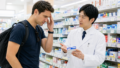
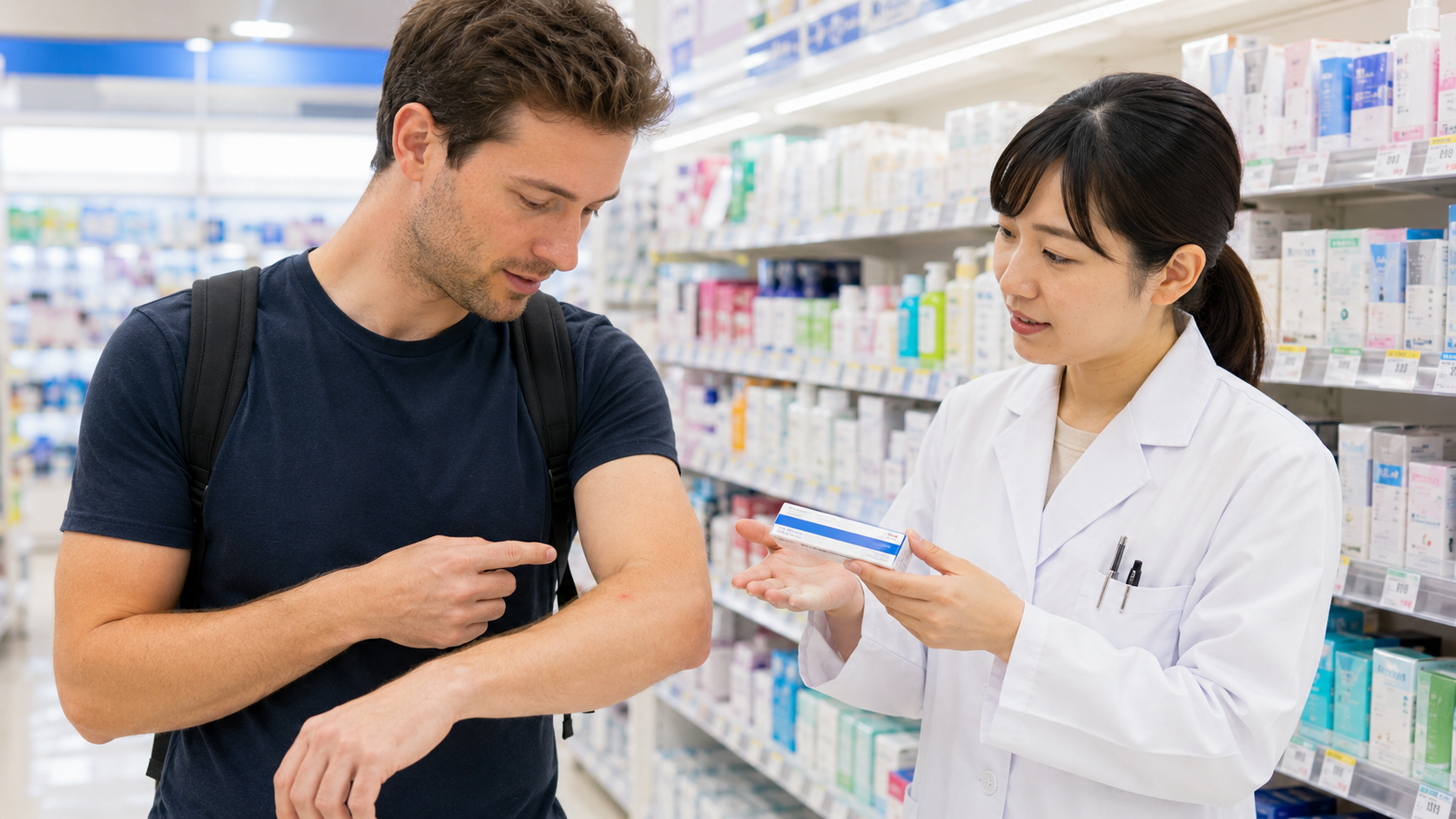
Skin rash, itching, mosquito bites, and minor skin irritation are common during travel or daily life in Japan. You may want to buy a cream, ointment, lotion, spray, patch, or antifungal medicine at a Japanese drugstore.
However, skin products are not all the same. A product for an insect bite is different from a product for athlete’s foot. A topical steroid may help some inflammatory rashes, but it may be the wrong choice for infected skin, fungal rash, painful blisters, or a rash caused by a medicine.
This article is a hub guide for OTC skin products in Japan. It gives a safe overview before more detailed guides on topical steroids, itch and insect bite products, antifungal medicines, and acne or bactericidal skin products.
This guide does not diagnose your rash and does not recommend a specific product. Use ingredient names as label-reading clues, and ask pharmacy staff whether a product matches your symptoms, skin area, and situation.
Some OTC medicines in Japan may require confirmation by a pharmacist or registered seller before purchase. Depending on the product, your symptoms, age, pregnancy status, skin area, medical history, or other medicines you use, the product may not be available or may not be appropriate.
- Quick Takeaway: Do Not Use the Same Cream for Every Rash
- Important Travel Note: When to Call 119
- At a Glance: Skin Symptoms and What to Check
- Ingredient Names Are Label Clues, Not Recommendations
- Product Type and Ingredient Overview
- 1. Itching or Insect Bite Products
- 2. Topical Steroid Creams
- 3. Athlete’s Foot, Tinea, and Fungal-Looking Rash
- 4. Acne or Bactericidal Support Products Are Not Antibiotics
- 5. Rash with Allergy-Like Symptoms
- 6. Rash That Looks Infected
- 7. Rash After a New Medicine
- 8. Where You Apply the Medicine Matters
- 9. How Long to Use OTC Skin Products
- Useful Phrase Examples to Show at a Japanese Pharmacy
- FAQ
- Related Guides
- References
Quick Takeaway: Do Not Use the Same Cream for Every Rash
Before buying an OTC skin product in Japan, first check:
- Is it itching, pain, swelling, blisters, scaling, pus, or an open wound?
- Is the rash small and mild, or spreading quickly?
- Is it on the face, around the eyes, lips, mouth, genitals, or a large body area?
- Is the skin broken, bleeding, warm, very painful, or infected-looking?
- Did it start after a new medicine, food, insect bite, plant exposure, cosmetic, or chemical?
- Is there fever, shortness of breath, facial swelling, dizziness, or widespread hives?
- Is it for a child, an elderly person, someone pregnant or breastfeeding, or someone with diabetes, poor circulation, immune problems, or fragile skin?
If the rash is severe, painful, rapidly spreading, infected-looking, or comes with whole-body symptoms, do not rely only on OTC cream. Seek medical care.
Important Travel Note: When to Call 119
If you may need medical care for a rash, infection, allergic reaction, or severe skin symptoms, see our guide: How to See a Doctor in Japan as a Traveler.
In Japan, call 119 for an ambulance if symptoms are severe or feel like an emergency. This includes trouble breathing, swelling of the face or throat, severe weakness, collapse, severe allergic symptoms, or a serious skin reaction after a medicine.
Rash after a new medicine can rarely be serious. Seek urgent medical care or call 119 if a rash comes with fever, strong illness, painful skin, blisters, peeling skin, eye redness, mouth sores, lip or genital sores, or a rash that spreads quickly. These can be warning signs of a serious drug reaction such as Stevens-Johnson syndrome or toxic epidermal necrolysis.
Ambulance transport in Japan is generally free, but hospital treatment, tests, prescriptions, and follow-up care are billed. Travel insurance is strongly recommended for visitors.
At a Glance: Skin Symptoms and What to Check
| Situation | What it may mean | What to check first |
| Itchy mosquito bite or mild insect bite | Local irritation may be possible | Check itch-relief ingredients, inflammation, broken skin, and infection signs |
| Red itchy rash after contact with something | Irritation or contact dermatitis may be possible | Check whether the area is small, mild, and not infected |
| Scaly itchy rash, especially between toes or in a ring shape | Fungal infection may be possible | Do not treat every scaly rash with steroid alone |
| Widespread hives or swelling | Allergic reaction may be possible | Seek urgent care if breathing symptoms, facial swelling, dizziness, or collapse occurs |
| Painful blisters or one-sided burning rash | Shingles or another infection may be possible | OTC creams may not be enough |
| Pus, increasing redness, warmth, severe pain, or red streaks | Skin infection may be possible | Seek medical care rather than covering it with cream |
| Rash after a new medicine | Drug eruption may be possible | Seek urgent care if fever, blisters, mouth or eye symptoms, or feeling very unwell occurs |
Ingredient Names Are Label Clues, Not Recommendations
The ingredient names below are examples of names you may see on Japanese OTC skin products. They are not a shopping list and not recommendations.
The right choice depends on the cause of the rash, skin area, age, pregnancy or breastfeeding status, medical history, allergies, and whether the skin is broken or infected.
External medicines are not automatically safe for every situation. A cream can still cause irritation, allergy, side effects, or delayed medical care if used on the wrong condition.
Always read the label and package insert. Product-specific “do not use” and “ask before use” warnings matter.
Product Type and Ingredient Overview
| Product type | Ingredient names you may see | Why it matters |
| Itch-relief ingredients | diphenhydramine, crotamiton, lidocaine, dibucaine, menthol, camphor | May be used for itching or insect-bite discomfort; check broken skin, sensitive areas, and allergies |
| Anti-inflammatory non-steroid ingredients | glycyrrhetinic acid, allantoin | May appear in products for irritation or redness; still check the cause of the rash |
| Topical steroid ingredients | hydrocortisone acetate, prednisolone valerate acetate, dexamethasone acetate, betamethasone valerate, fluocinolone acetonide | May reduce inflammation, but wrong use can worsen infection or fungal rash |
| Antifungal ingredients for tinea or athlete’s foot | terbinafine hydrochloride, butenafine hydrochloride, miconazole nitrate, clotrimazole, and related antifungals | Used for fungal skin problems such as athlete’s foot; not for every rash |
| Vaginal candidiasis-related antifungal products | clotrimazole, miconazole nitrate, and related antifungals | This is a different situation from athlete’s foot and may have stricter purchase and use conditions |
| Bactericidal or acne-related support ingredients | isopropyl methylphenol, benzalkonium chloride | May appear in acne, itch, or skin-support products; not the same as an antibiotic and not enough for infected-looking skin |
1. Itching or Insect Bite Products
Japanese drugstores sell many products for itching, mosquito bites, and mild insect-bite irritation. These may be creams, gels, liquids, patches, or sprays.
Ingredient names you may see include:
- diphenhydramine
- crotamiton
- lidocaine
- dibucaine
- menthol
- camphor
- glycyrrhetinic acid
- allantoin
These ingredients may be used to reduce itching, discomfort, or local irritation. However, do not apply these products to deep wounds, severe burns, infected skin, eyes, mouth, or large areas unless pharmacy staff confirms it is appropriate.
Be careful with products that contain local anesthetic ingredients such as lidocaine or dibucaine if the skin is broken, irritated, or being used on a child. Check the exact product label.
If the bite area becomes more painful, hot, swollen, red, or has pus, it may need medical care rather than more itch cream.
2. Topical Steroid Creams
Some Japanese OTC creams contain topical steroid ingredients. However, steroid products are not for every rash.
Ingredient names you may see include:
- hydrocortisone acetate
- prednisolone valerate acetate
- dexamethasone acetate
- betamethasone valerate
- fluocinolone acetonide
Steroid strength and appropriate use vary by product. Ask pharmacy staff before using steroid-containing products on the face, around the eyes, lips, genitals, large areas, broken skin, children, pregnancy, breastfeeding, or repeated symptoms.
Avoid using a steroid-containing product on your own if the rash may be:
- athlete’s foot, ringworm, candida, or another fungal rash
- infected-looking, with pus, warmth, spreading redness, or severe pain
- viral-looking, blistering, or shingles-like
- on deep wounds, severe burns, eyes, mouth, or mucous membranes
- caused by a new medicine
Wrong steroid use can worsen infection or fungal rash, hide important symptoms, or delay medical care.
Use only as directed on the label. If symptoms do not improve, worsen, spread, or keep returning, seek medical care.
3. Athlete’s Foot, Tinea, and Fungal-Looking Rash
Some itchy rashes are fungal rather than ordinary irritation. Athlete’s foot, ringworm-like rash, or itchy scaling between the toes may need antifungal medicine rather than itch cream or steroid cream.
Ingredient names you may see include:
- terbinafine hydrochloride
- butenafine hydrochloride
- miconazole nitrate
- clotrimazole
- related antifungal ingredients
Antifungal products are not for every rash. Ask pharmacy staff if you are not sure whether the rash looks fungal.
Be especially careful if the rash is on the face, scalp, nails, genitals, large areas, or if the person has diabetes, poor circulation, immune problems, severe cracking, bleeding, or signs of infection.
Do not cover a fungal-looking rash with steroid cream on your own.
Vaginal or Genital Symptoms Are Different
Clotrimazole and miconazole nitrate may also appear in products related to vaginal candidiasis. This is not the same as treating athlete’s foot.
Vaginal candidiasis OTC products in Japan may have stricter purchase and use conditions. They may be intended for recurrence after a previous doctor diagnosis, not for a first episode or unclear genital symptoms.
Do not choose an antifungal product casually for genital symptoms, unusual discharge, pelvic or lower abdominal pain, fever, pregnancy, repeated symptoms, or symptoms that may be a sexually transmitted infection. Ask a pharmacist or doctor.
4. Acne or Bactericidal Support Products Are Not Antibiotics
Some skin products contain bactericidal or support ingredients such as:
- isopropyl methylphenol
- benzalkonium chloride
Isopropyl methylphenol may appear in acne-related, itch-related, or skin-support products. It is better to treat it as a bactericidal support ingredient, not as a general “disinfection answer” for infected skin.
These ingredients are not the same as prescription antibiotics. Do not rely on them for a painful, spreading, hot, swollen, or pus-filled rash.
If the skin looks infected, seek medical care.
5. Rash with Allergy-Like Symptoms
If you have widespread hives, swelling, or itching after food, medicine, insect sting, cosmetics, plants, or chemicals, the issue may be allergy-related.
Cream alone may not be enough for widespread symptoms. Seek urgent medical care or call 119 if you have trouble breathing, swelling of the face or throat, dizziness, fainting, or rapidly spreading hives.
For allergy-related OTC medicines, you may also want to read: Runny Nose and Allergy Medicine in Japan: Antihistamines and Nasal Sprays.
6. Rash That Looks Infected
Do not rely on OTC cream if the skin looks infected.
Warning sign examples include:
- increasing redness
- warmth
- swelling
- worsening pain
- pus
- red streaks
- fever
- symptoms that spread quickly
Infection may need medical evaluation and treatment that is not available as a simple OTC cream.
7. Rash After a New Medicine
A rash after starting a new medicine can be important. This includes prescription medicine, OTC medicine, supplements, herbal products, and medicine you brought from another country.
Do not simply cover a new medicine-related rash with cream. Seek urgent medical care or call 119 if the rash is widespread, painful, blistering, comes with fever, affects the mouth or eyes, involves lips or genitals, or you feel very unwell.
If you go to a pharmacy or clinic, show the medicine package or a photo of the medicine.
8. Where You Apply the Medicine Matters
Before using any OTC skin product, check whether it is appropriate for the body area.
Ask pharmacy staff before applying products to:
- face
- around the eyes
- lips or mouth
- genitals
- large areas
- broken or bleeding skin
- deep wounds
- severe burns
- children
- elderly people with fragile skin
The same ingredient may be acceptable on one body area but inappropriate on another.
9. How Long to Use OTC Skin Products
Do not keep using or switching OTC creams for a long time without advice.
Before using a product, check:
- how many times per day to apply it
- how many days to use it
- whether it can be used on your skin area
- whether it can be used with other skin products
- when to stop and seek medical care
If the rash does not improve, gets worse, spreads, or keeps coming back, seek medical care.
Useful Phrase Examples to Show at a Japanese Pharmacy
These are example phrases. Choose only the phrases that match your situation.
| What you mean | Japanese to show |
| I have a rash. | 発疹があります。 |
| My skin is itchy. | 皮膚がかゆいです。 |
| I was bitten by an insect. | 虫に刺されました。 |
| The rash is spreading. | 発疹が広がっています。 |
| The area is painful. | その部分が痛いです。 |
| There is pus. | 膿が出ています。 |
| I want to know if this can be treated with OTC medicine. | 市販薬で対応してよいか確認したいです。 |
| I want to know if I should see a doctor. | 受診した方がよい症状か教えてください。 |
| Can I use this on my face? | 顔に使ってもよいですか? |
| Can I use this around the eye? | 目の周りに使ってもよいですか? |
| I am pregnant or breastfeeding. | 妊娠中、または授乳中です。 |
| This medicine is for a child. | 子どもに使う薬です。 |
| This rash started after I took a medicine. | 薬を飲んだあとに発疹が出ました。 |
For a ready-to-show bilingual card, see: Show This at a Japanese Pharmacy: OTC Medicine Questions in English and Japanese.
FAQ
Can I buy itch cream at a drugstore in Japan?
Yes, many Japanese drugstores sell OTC creams and other products for itching, insect bites, and mild skin irritation. However, the right product depends on the cause, skin area, severity, age, pregnancy status, and whether infection or fungal rash is possible.
Can I buy steroid cream in Japan?
Some topical steroid products are available as OTC medicines in Japan. However, they are not appropriate for every rash. Ask pharmacy staff before using them on the face, around the eyes, genitals, large areas, broken skin, children, pregnancy, or symptoms that may be infected or fungal.
Should I use steroid cream for athlete’s foot?
Do not use steroid cream alone for a fungal-looking rash on your own. Athlete’s foot or ringworm-like rash may need antifungal medicine, and steroid use may be inappropriate.
Are clotrimazole and miconazole nitrate for athlete’s foot or candida?
They are antifungal ingredients, but the product purpose matters. Some products are for athlete’s foot or tinea, while some vaginal candidiasis products may use related antifungal ingredients and may have stricter purchase and use conditions. Do not use a vaginal candidiasis product for ordinary skin rash, and do not self-treat unclear genital symptoms.
Is isopropyl methylphenol an antibiotic?
No. Isopropyl methylphenol is a bactericidal support ingredient that may appear in acne-related, itch-related, or skin-support products. It is not the same as a prescription antibiotic and should not be relied on for infected-looking skin.
When should I call 119 for a rash in Japan?
Call 119 or seek urgent medical care if a rash comes with trouble breathing, face or throat swelling, collapse, severe weakness, fever with painful rash, blisters, peeling skin, mouth or eye symptoms, or severe symptoms after taking a medicine.
Related Guides
You may also want to read:
- Drugstore Basics in Japan: How to Buy OTC Medicine Safely
- Runny Nose and Allergy Medicine in Japan: Antihistamines and Nasal Sprays
- Show This at a Japanese Pharmacy: OTC Medicine Questions in English and Japanese
References
- Ministry of Health, Labour and Welfare. Information on the Japanese medicine sales system.
- Pharmaceuticals and Medical Devices Agency (PMDA). OTC medicine package insert information search.
- PMDA Alert for Proper Use of Drugs. Serious skin disorders including Stevens-Johnson syndrome.
- Japan National Tourism Organization (JNTO). For safe travels in Japan: Guide for when you are feeling ill.
- Mayo Clinic. Stevens-Johnson syndrome.
- Mayo Clinic. Contact dermatitis.
- Mayo Clinic. Bee stings.