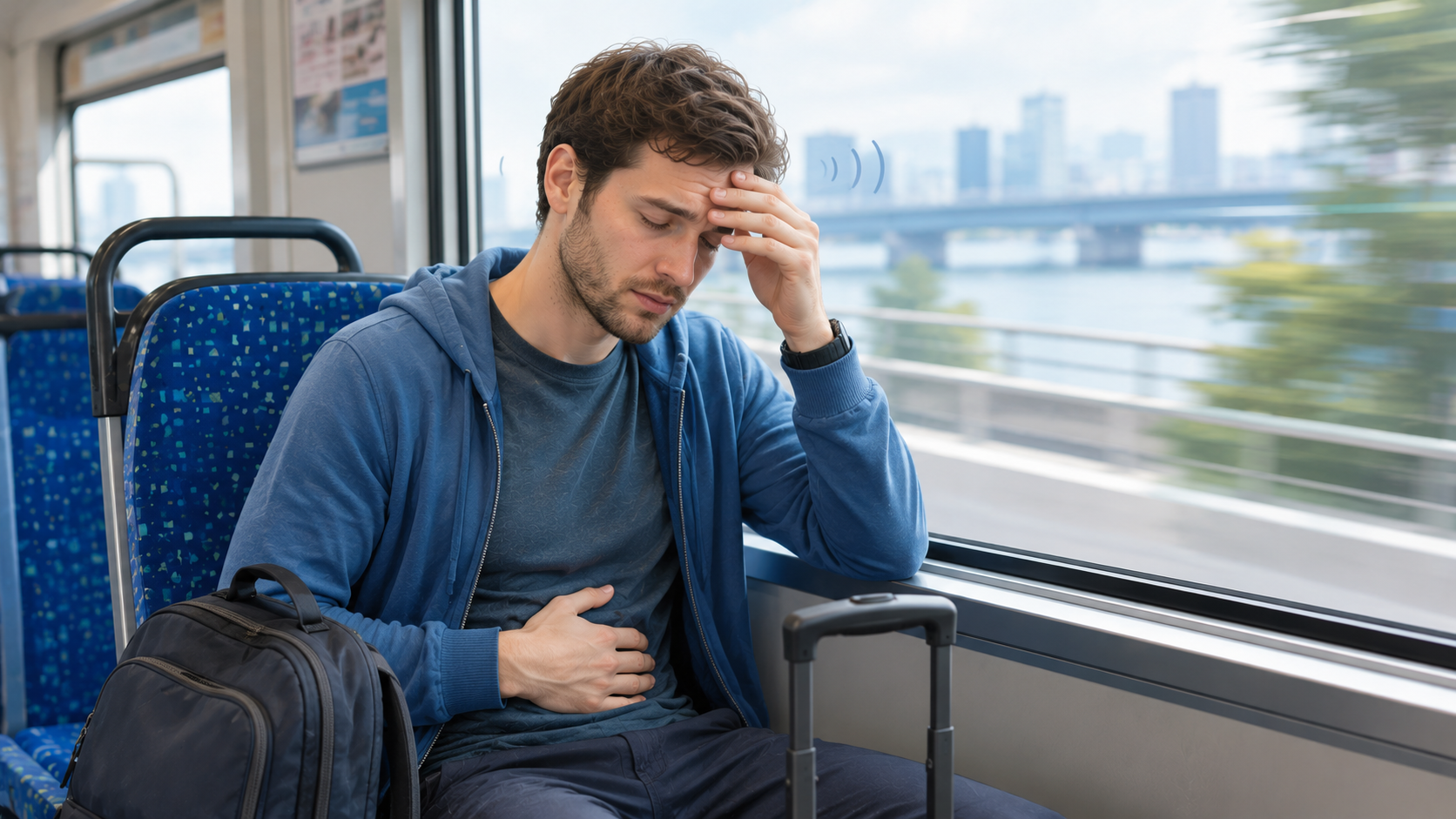
Motion sickness can happen during travel by car, bus, train, boat, plane, taxi, or sightseeing tour. It may cause nausea, dizziness, sweating, headache, pale skin, or vomiting. Japanese drugstores often sell OTC motion sickness medicines, but they are not the same as general nausea medicine for food poisoning, infection, severe stomach illness, or repeated unexplained vomiting.
This guide explains what to check before buying OTC motion sickness medicine in Japan. It does not recommend a specific product. Use ingredient names as label clues, and ask pharmacy staff if you are unsure. Each product has its own warnings, contraindications, and “do not use” instructions, so ask a pharmacist or registered seller whether the medicine can be used in your situation.
- Quick Guide: What to Check First
- Motion Sickness Medicine Is Not General Nausea Medicine
- Ingredient Names You May See on Japanese Labels
- Timing Matters: Before the Ride or After Symptoms Start?
- Sleepiness, Alcohol, and Other Medicines
- Ask Pharmacy Staff First in These Situations
- When Medical Care May Be Safer
- Simple Non-Medicine Tips During Travel
- How to Ask at a Japanese Pharmacy
- Related Guides
- References
Quick Guide: What to Check First
| Situation | What to do first |
| You know you get motion sickness | Ask pharmacy staff about OTC motion sickness medicine before the ride. |
| You are already nauseous during travel | Check whether the product can be used after symptoms start, and follow the package directions. |
| The medicine is for a child or elderly person | Check the age limit and ask pharmacy staff before use. |
| You need to drive, cycle, drink alcohol, or stay alert | Be careful. Many motion sickness medicines can cause sleepiness. |
| Vomiting is repeated, severe, unexplained, or comes with fever, severe pain, dehydration, or head injury | Do not treat it as simple motion sickness. Consider medical care. |
In short: motion sickness medicine is mainly for nausea and dizziness related to movement. If your symptoms do not clearly fit motion sickness, ask pharmacy staff or consider medical care.
Motion Sickness Medicine Is Not General Nausea Medicine
OTC motion sickness medicine is designed for travel-related nausea, such as nausea during a car ride, bus trip, boat ride, flight, train ride, mountain road, or amusement ride.
It is not meant for every type of nausea or vomiting. Be more careful if nausea or vomiting may be related to:
- food poisoning
- stomach infection
- heat illness
- pregnancy
- head injury
- severe headache
- strong abdominal pain
- repeated vomiting
- dehydration
If you are not sure whether your symptoms are motion sickness, it is better to ask pharmacy staff before choosing a product.
Ingredient Names You May See on Japanese Labels
These ingredient names are label clues, not recommendations. Products may contain one or more ingredients, and some products include additional ingredients such as caffeine or vitamins.
Common motion sickness-related ingredient names you may see include:
- meclizine hydrochloride
- dimenhydrinate
- diphenhydramine salicylate
- scopolamine hydrobromide hydrate
Some of these ingredients are antihistamine-type or anticholinergic-type ingredients. They may help with motion sickness-related nausea or dizziness, but they can also cause side effects such as sleepiness, dry mouth, blurred vision, or difficulty urinating.
Do not choose only by the ingredient name. Check the age limit, dose, timing, warnings, and whether pharmacist or registered seller support is needed.
Timing Matters: Before the Ride or After Symptoms Start?
Some motion sickness medicines are intended to be taken before travel. Others may have directions for use after symptoms start. The timing, dose, and repeat-use rules differ by product.
Before a long ride, check:
- when to take it
- how often it can be taken
- the maximum daily dose
- whether it can be used after symptoms start
- whether it is appropriate for your age
- whether it can be used with your other medicines
If the label is difficult to understand, show the package to pharmacy staff and ask them to explain the timing.
Sleepiness, Alcohol, and Other Medicines
Many motion sickness medicines can make you sleepy. This matters if you plan to drive, cycle, ski, hike, drink alcohol, or do an activity that requires attention.
Be especially careful if you are also using:
- cold medicine
- allergy medicine
- sleep aids
- sedatives
- other motion sickness medicine
- medicines that already make you sleepy
Do not combine multiple OTC medicines on your own. If you have more than one symptom, ask pharmacy staff which product is appropriate instead of stacking several medicines.
Ask Pharmacy Staff First in These Situations
Ask pharmacy staff before using motion sickness medicine if:
- the medicine is for a child
- the medicine is for an elderly person
- you are pregnant or breastfeeding
- you have glaucoma
- you have difficulty urinating or prostate problems
- you have heart disease
- you have liver or kidney disease
- you take other medicines
- you need to stay alert during travel
This does not always mean you cannot use anything. It means the choice should be checked carefully.
When Medical Care May Be Safer
Consider medical care instead of relying on OTC motion sickness medicine if you have:
- repeated vomiting
- inability to keep fluids down
- signs of dehydration
- fever
- severe abdominal pain
- severe headache
- symptoms after a head injury
- confusion, fainting, weakness, or trouble walking
- blood in vomit or stool
- suspected food poisoning
- symptoms that are getting worse or not improving
If the situation feels severe or urgent, ask nearby staff for help or call 119 in Japan.
If you are not sure how to find medical care in Japan, see our guide: How to See a Doctor in Japan as a Traveler.
Simple Non-Medicine Tips During Travel
These steps may help reduce motion sickness symptoms:
- Sit where motion feels smaller, such as the front seat of a car or the middle area of a boat.
- Look at a fixed point, such as the horizon.
- Get fresh air if possible.
- Avoid reading or watching videos during the ride.
- Avoid heavy meals, spicy foods, and alcohol before or during travel.
- Take breaks during long trips if possible.
- Drink small amounts of water if you can.
These steps may not be enough for everyone, but they can be useful before or along with pharmacy advice.
How to Ask at a Japanese Pharmacy
You can show these phrases to pharmacy staff.
| What you mean | Japanese to show |
| I get motion sickness. | 乗り物酔いしやすいです。 |
| I feel nauseous during car, bus, boat, or train rides. | 車、バス、船、電車で気持ち悪くなります。 |
| I want motion sickness medicine for travel. | 旅行中に使う乗り物酔いの薬を探しています。 |
| Can this be taken before the ride? | 乗る前に飲む薬ですか? |
| Can this be used after symptoms start? | 症状が出てからでも使えますか? |
| Does this medicine cause sleepiness? | この薬は眠くなりますか? |
| Is this medicine OK for a child / elderly person? | 子ども/高齢者でも使えますか? |
| I also take other medicines. | 他にも薬を飲んでいます。 |
| Please tell me whether I should see a doctor. | 受診した方がよい症状か教えてください。 |
For a broader pharmacy communication card, see: Show This at a Japanese Pharmacy: OTC Medicine Questions in English and Japanese.
Related Guides
You may also want to read:
- Stomach and Digestive Problems in Japan: OTC Medicine Ingredients and Safety Checks
- How to See a Doctor in Japan as a Traveler
- Drugstore Basics in Japan: How to Buy OTC Medicine Safely
References
- Pharmaceuticals and Medical Devices Agency (PMDA). OTC medicine and package insert search. https://www.pmda.go.jp/PmdaSearch/otcSearch/
- NHS. Motion sickness. https://www.nhs.uk/conditions/motion-sickness/