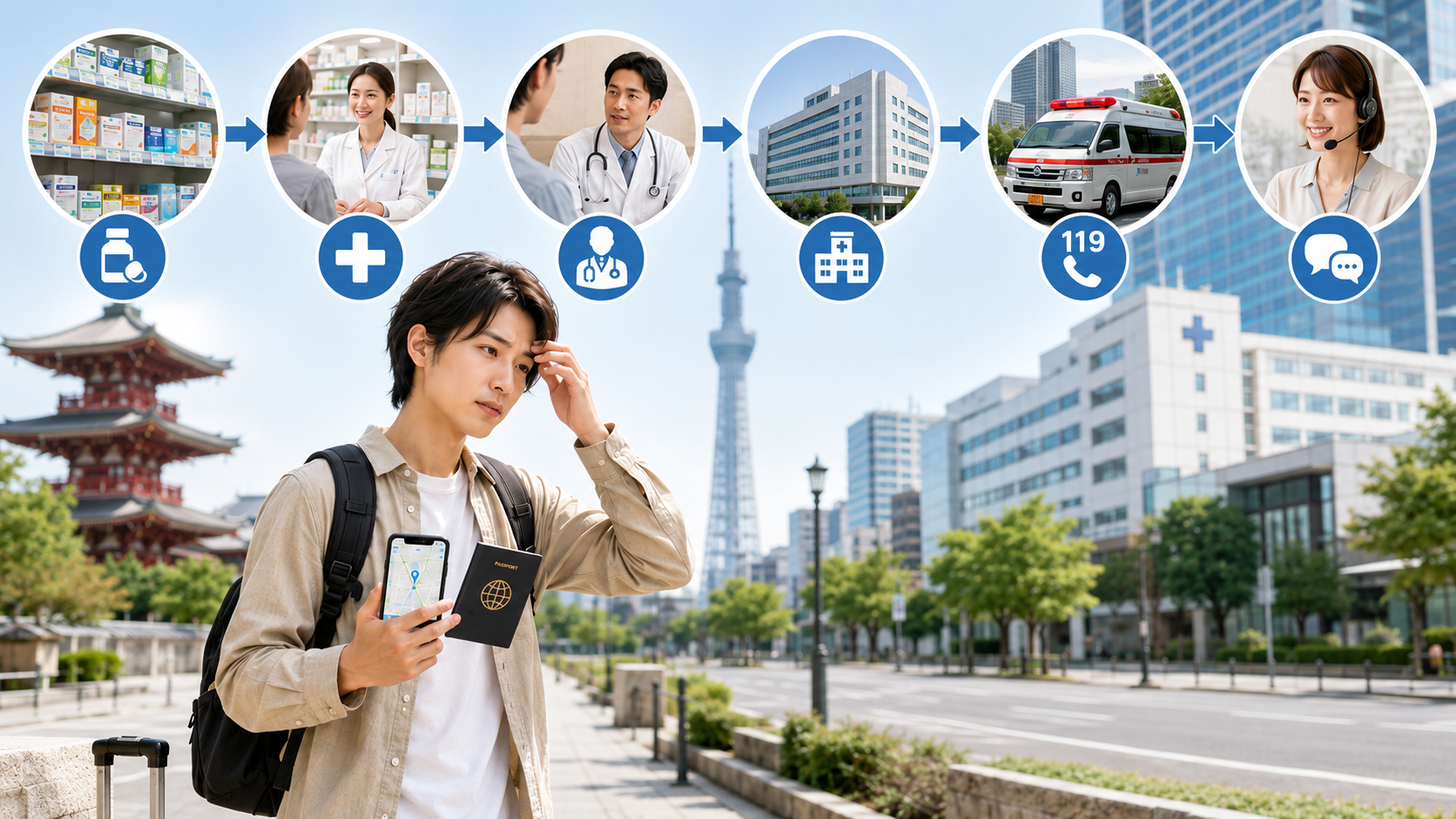
If you feel sick while traveling in Japan, the fastest first question is:
Do I need emergency help, a doctor, or just pharmacy advice?
Use this quick guide to choose between a drugstore, pharmacy, clinic, hospital, or 119.
Quick Answer: Where Should You Go?
| Situation | First place to consider |
| Mild symptoms and an OTC medicine question | Drugstore or pharmacy |
| You need medicine advice or prescription-related help | Pharmacy / pharmacist, or drugstore staff |
| You feel unwell but it is not an emergency | Clinic during regular hours |
| You may need tests, specialist care, or after-hours care | Hospital or local after-hours clinic |
| Severe or urgent symptoms | Call 119 for an ambulance |
| You need help finding English-friendly care | JNTO medical institution search or Japan Visitor Hotline |
This article is a practical navigation guide for travelers. It is not a diagnosis or personal medical advice.
The Most Important Things First
- Call 119 if symptoms feel severe or urgent, such as serious injury, severe chest pain, trouble breathing, loss of consciousness, stroke-like symptoms, severe allergic reaction, major bleeding, or severe worsening illness.
- Go to a drugstore or pharmacy for mild symptoms and OTC medicine questions.
- Go to a clinic if you think you need a doctor but it is not an emergency.
- Use a hospital or after-hours service if symptoms are more serious, you need tests, or regular clinics are closed.
- Bring your passport, travel insurance details, medicines, allergy list, and payment method.
- Not every clinic or pharmacy can support English, so call ahead when possible.
Drugstore or Pharmacy?
In Japan, travelers often use drugstores for OTC medicines, masks, first-aid items, oral rehydration products, and basic symptom questions.
A pharmacy may mean a place that dispenses prescription medicine. Some large drugstores also have a prescription pharmacy counter inside.
Ask a pharmacist or registered seller if you are unsure which OTC medicine fits your symptoms. Some medicines may not be available if the pharmacist is not present.
For OTC buying basics, see: Drugstore Basics in Japan: How to Buy OTC Medicine Safely.
For phrases to show staff, see: Show This at a Japanese Pharmacy: OTC Medicine Questions in English and Japanese.
Clinic or Hospital?
If you need a doctor but it is not an emergency, a clinic is often the simpler first step during regular hours.
Common examples include fever that is not improving, strong sore throat, worsening cough, stomach pain, skin rash, ear pain, urinary symptoms, or symptoms that feel unusual for you.
A hospital may be better if symptoms are more serious, you may need tests or specialist care, or clinics are closed. After-hours options vary by region.
For a fuller step-by-step guide, see: How to See a Doctor in Japan as a Traveler.
When to Call 119
In Japan, 119 is the emergency number for ambulance and fire.
Call 119 if you think waiting could be dangerous. Examples include severe chest pain, trouble breathing, unconsciousness, serious injury, heavy bleeding, severe allergic reaction, severe weakness or numbness, confusion, seizure, or sudden severe symptoms.
Useful phrase:
救急車を呼んでください。
Please call an ambulance.
You usually cannot choose the hospital the ambulance takes you to. Emergency teams choose based on your condition and available facilities.
How to Find Medical Care in English
The JNTO medical guide lets travelers search medical institutions by area, language, and medical department.
JNTO also lists the Japan Visitor Hotline for foreign visitors who need assistance with illness, disaster, or travel-related problems:
050-3816-2787
24 hours a day, 365 days a year
Languages: English, Chinese, Korean
Japan’s Ministry of Health, Labour and Welfare also provides Medical Information Net (NABII), where users can search medical institutions and pharmacies.
Cost and Travel Insurance
Clinic and hospital care in Japan is usually not free for short-term travelers.
If you are not covered by Japanese public health insurance or a cashless travel insurance arrangement, you may need to pay the full medical cost yourself at the facility. Costs can become high without travel insurance, especially for emergency care, tests, hospitalization, surgery, or medical transport.
Ask about payment at reception when possible, and keep receipts and medical documents for insurance claims.
Quick Japanese Phrases
You can show these phrases:
| English meaning | Japanese to show |
| I feel sick. | 体調が悪いです。 |
| Is a drugstore enough, or should I see a doctor? | ドラッグストアでよいですか、それとも受診した方がよいですか? |
| Is there a clinic nearby? | 近くにクリニックはありますか? |
| Is there an English-speaking clinic? | 英語対応のクリニックはありますか? |
| Please call an ambulance. | 救急車を呼んでください。 |
| I have travel insurance. | 海外旅行保険に入っています。 |
| I take these medicines. | これらの薬を飲んでいます。 |
| I have this allergy. | このアレルギーがあります。 |
Bottom Line
If you feel sick in Japan, do not start with a product name or hospital name.
Start with the level of urgency:
- Emergency: call 119.
- Need a doctor: clinic during regular hours, hospital or after-hours care when needed.
- Mild symptoms / OTC question: drugstore or pharmacy.
- Need English-friendly care: use JNTO medical search or the Japan Visitor Hotline.
For most mild travel symptoms, a drugstore or pharmacy may be enough. For symptoms that are strong, unusual, worsening, or worrying, seeing a doctor is the safer next step.
Related Guides
- Drugstore Basics in Japan: How to Buy OTC Medicine Safely
- Show This at a Japanese Pharmacy: OTC Medicine Questions in English and Japanese
- How to See a Doctor in Japan as a Traveler
- Fever in Japan: How to Choose OTC Medicine Safely as a Traveler or Resident
- Heat Illness in Japan: What Travelers Should Check Before Taking Fever Medicine
- Diarrhea Medicine in Japan: OTC Options and When Travelers Should Seek Care
References
- Japan National Tourism Organization (JNTO). For safe travels in Japan – Guide for when you are feeling ill. https://www.jnto.go.jp/emergency/eng/mi_guide.html
- Ministry of Health, Labour and Welfare. Medical Information Net (NABII). https://www.iryou.teikyouseido.mhlw.go.jp/znk-web/juminkanja/S2300/initialize
- Ministry of Health, Labour and Welfare. List of medical institutions accepting foreign patients. https://www.mhlw.go.jp/stf/newpage_05774.html
- Ministry of Health, Labour and Welfare. We strongly recommend enrolling in private health insurance for international visitors. https://www.mhlw.go.jp/stf/newpage_46516.html
- Fire and Disaster Management Agency. 119 emergency calls. https://www.fdma.go.jp/mission/enrichment/kyukyumusen_kinkyutuhou/119.html