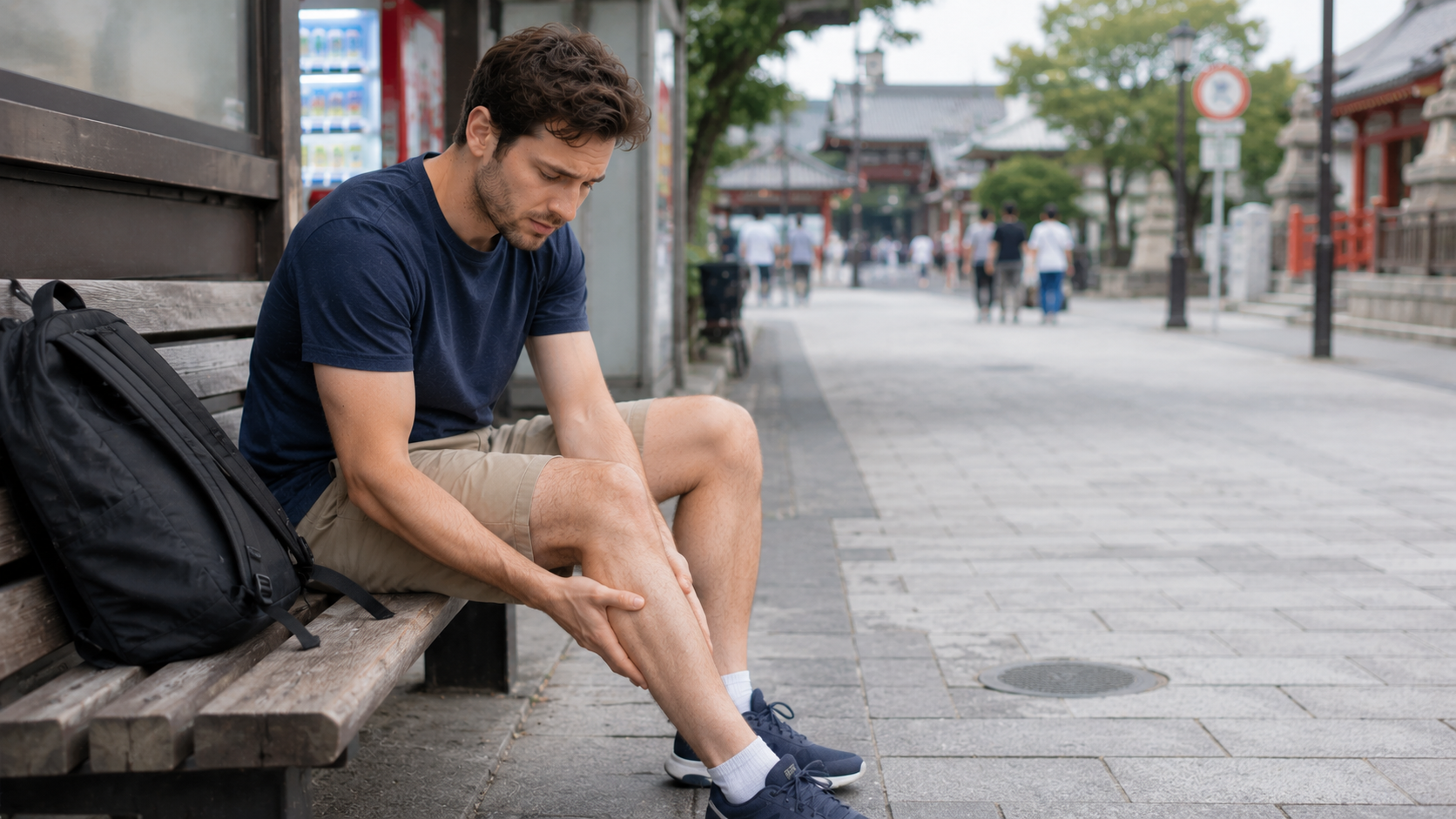
Muscle pain, joint pain, back pain, shoulder stiffness, and foot pain are common during travel in Japan. Long walks, stairs, luggage, hiking, theme parks, unfamiliar beds, and long train or bus rides can all make your body hurt.
Japanese drugstores sell many OTC products for muscle and joint pain, including patches, tapes, gels, creams, sprays, cooling products, warming products, and oral pain relievers. This guide explains what to check before buying them. It does not recommend a specific product. Ingredient names are label clues only. Each product has its own warnings, contraindications, and “do not use” instructions, so ask a pharmacist or registered seller whether the medicine can be used in your situation.
Quick Guide: What Should You Check First?
| Situation | What to check first |
| Sore muscles after walking or carrying luggage | A topical patch, gel, cream, or spray may be an option. Check the label and ask pharmacy staff. |
| Joint pain, back pain, shoulder pain, or foot pain | Check whether the product is for muscle/joint pain and whether the painful area has swelling, redness, injury, or numbness. |
| You want a patch or tape | Check how long to leave it on, how many can be used, and whether it is cooling, warming, or medicated. |
| You want a gel, cream, or spray | Check where it can be applied, how often, and whether it should be kept away from eyes, wounds, and broken skin. |
| Pain is severe, sudden, after an injury, or comes with swelling, deformity, fever, numbness, weakness, chest pain, or trouble walking | Consider medical care instead of relying on OTC medicine. |
In short: first decide whether this looks like mild soreness, a local muscle/joint problem, or something more serious. OTC products may help mild local pain, but they are not a substitute for medical care after a significant injury or unusual symptoms.
What Types of Products Can You Find in Japan?
At Japanese drugstores, you may see several types of OTC products for muscle or joint pain.
Patches and tapes
Patches and tapes are common in Japan. Some feel cooling, some feel warming, and some contain anti-inflammatory or pain-relief ingredients. They may be used for local pain such as shoulder stiffness, back pain, muscle soreness, or joint pain, depending on the product.
Check:
- how long to keep the patch on
- how many patches can be used at once
- whether it is cooling or warming
- whether it can be used on the painful area
- whether it has age limits
- whether it should be avoided with heat packs or after bathing
Gels, creams, liquids, and sprays
Gels, creams, liquids, and sprays may be easier to use on areas where a patch does not stick well. They can also be useful for people who dislike adhesive patches.
Check:
- how often to apply it
- whether it should be rubbed in
- whether to wash your hands after use
- whether it can be used near the neck, face, or sensitive skin
- whether it must be kept away from eyes, mouth, wounds, and broken skin
Oral pain relievers
Some people may think of oral pain relievers for muscle or joint pain. In Japan, oral pain reliever labels may include ingredients such as acetaminophen/paracetamol, ibuprofen, or loxoprofen sodium hydrate.
Oral pain relievers can affect the whole body. They may not be suitable for everyone, especially if you have stomach or duodenal ulcer history, kidney disease, liver disease, heart disease, asthma related to NSAIDs, are pregnant, take blood thinners, or already use other pain medicines. OTC oral loxoprofen products are first-class OTC medicines in Japan, so pharmacist confirmation is required.
For more detail on oral pain relievers, see: Headache Medicine in Japan: OTC Pain Relievers and Safety Checks.
If your pain is local, ask pharmacy staff whether a topical product or another option is more appropriate for your situation.
Ingredient Names You May See on Labels
These names are label clues, not recommendations. The same ingredient can have different warnings depending on the product, dose, form, and where it is applied.
Topical anti-inflammatory or pain-relief ingredients
You may see ingredient names such as:
- loxoprofen sodium hydrate
- diclofenac sodium
- felbinac
- indomethacin
- ketoprofen
These ingredients are often used in products for muscle pain, joint pain, shoulder stiffness, back pain, or inflammation-related local pain. They are not automatically appropriate for every person or every painful area.
For topical NSAID products, key label checks often include allergy to the ingredient, asthma triggered by pain relievers, age limits, pregnancy, older age, whether you are under medical treatment, and whether you are already using another topical anti-inflammatory or pain-relief medicine. Warnings differ by product, so ask pharmacy staff before use if you have a medical condition, take other medicines, or are unsure.
Cooling, warming, or counter-irritant ingredients
You may also see ingredients such as:
- l-menthol
- dl-camphor
- methyl salicylate
- glycol salicylate
- nonylic acid vanillylamide
- capsicum extract
These ingredients may create a cooling or warming sensation, or help distract from local discomfort. A strong cooling or warming feeling does not always mean the product is stronger or better for your condition.
Avoid using these products on broken skin, rash, eczema, wounds, mucous membranes, or near the eyes. Stop use and ask for help if you develop a strong rash, blistering, swelling, or burning sensation.
Important Safety Checks for Patches and Gels
Before using a patch, gel, cream, liquid, or spray, check the package carefully.
Do not use these products casually on:
- broken skin
- cuts or wounds
- rash, eczema, or infected-looking skin
- the eyes or around the eyes
- mucous membranes
- large areas of skin unless the package allows it
- areas where you already applied another topical medicine
Also be careful with:
- heat packs or electric heating pads
- hot baths immediately before or after use
- tight bandages over medicated products
- using several patches at once
- using the product longer than directed
- using topical and oral pain medicines together without asking pharmacy staff
Some products, especially certain ketoprofen-containing products, may have sun-sensitivity warnings. Ask pharmacy staff whether you need to avoid sunlight or cover the area after use.
When Pain May Need Medical Care
Consider medical care instead of relying on OTC medicine if you have:
- pain after a fall, accident, or strong injury
- a body part that looks deformed or cannot move normally
- severe swelling, bruising, redness, or warmth around a joint
- inability to walk or put weight on the area
- numbness, tingling, weakness, or loss of feeling
- back pain with leg weakness, bladder or bowel changes, or numbness around the groin area
- chest pain, shortness of breath, or pain spreading to the arm, jaw, or back
- calf swelling or pain after a long flight or long travel
- fever or feeling very unwell
- pain that is getting worse or not improving
If the situation feels severe or urgent, ask nearby staff for help or call 119 in Japan.
If you are not sure how to find medical care in Japan, see our guide: How to See a Doctor in Japan as a Traveler.
Simple Self-Care for Mild Soreness
For mild soreness after walking or carrying luggage, these steps may help while you decide whether to use an OTC product:
- Rest the painful area when possible.
- Avoid pushing through severe pain.
- Use comfortable shoes and reduce heavy carrying.
- For recent sprains or strains, cold packs may help early swelling.
- For stiffness or muscle tightness without swelling, gentle warmth may feel better for some people.
- Stretch gently only if it does not worsen the pain.
- Drink water and take breaks during long sightseeing days.
Do not use heat, massage, or strong stretching on a painful injury that is swollen, bruised, or getting worse.
How to Ask at a Japanese Pharmacy
You can show these phrases to pharmacy staff.
| What you mean | Japanese to show |
| My muscles are sore from walking. | 歩きすぎて筋肉痛があります。 |
| My shoulder / back / knee / ankle hurts. | 肩/腰/膝/足首が痛いです。 |
| I am looking for a patch or gel for local pain. | 局所の痛みに使う湿布やゲルを探しています。 |
| Can I use this on this area? | この場所に使えますか? |
| How long should I keep this patch on? | この湿布は何時間貼ればよいですか? |
| I already use or plan to use oral pain medicine. Can I use this topical product? | 飲み薬の痛み止めを使っています/使う予定です。この外用薬を使ってよいか確認したいです。 |
| I have asthma / kidney disease / stomach or duodenal ulcer history. | 喘息/腎臓病/胃潰瘍・十二指腸潰瘍の既往があります。 |
| I am pregnant or breastfeeding. | 妊娠中または授乳中です。 |
| Please tell me whether I should see a doctor. | 受診した方がよい症状か教えてください。 |
For a broader pharmacy communication card, see: Show This at a Japanese Pharmacy: OTC Medicine Questions in English and Japanese.
Related Guides
You may also want to read:
- Headache Medicine in Japan: OTC Pain Relievers and Safety Checks
- Fever in Japan: How to Choose OTC Medicine Safely as a Traveler or Resident
- Drugstore Basics in Japan: How to Buy OTC Medicine Safely
- How to See a Doctor in Japan as a Traveler
References
- Pharmaceuticals and Medical Devices Agency (PMDA). OTC medicine and package insert search. https://www.pmda.go.jp/PmdaSearch/otcSearch/
- NHS. Sprains and strains. https://www.nhs.uk/conditions/sprains-and-strains/
- NHS. Back pain. https://www.nhs.uk/conditions/back-pain/
- NHS. Ibuprofen for adults. https://www.nhs.uk/medicines/ibuprofen-for-adults/
—