When buying allergy medicine in Japan, the active ingredient is important, but so is the dosing schedule.
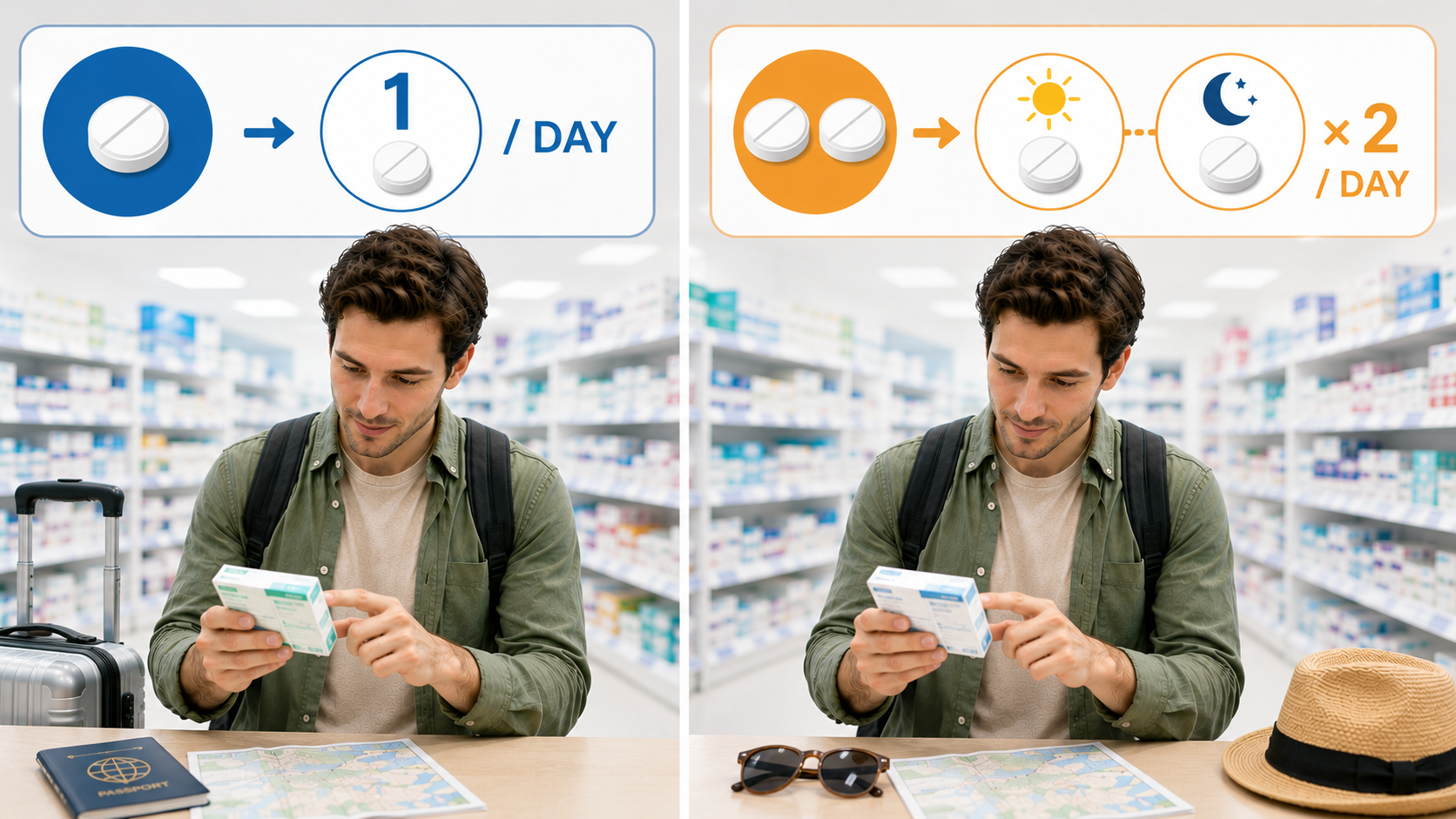
Some OTC antihistamines are usually taken once a day. Others are often taken twice a day. Combination cold or nasal medicines may have different schedules. For travelers, this matters because missed doses, doubled doses, drowsiness, alcohol, and long travel days can all become practical problems.
This short guide explains how to check once-daily and twice-daily allergy medicine labels in Japan. It is not a product recommendation. Always follow the package directions and ask a pharmacist or registered seller if you are unsure.
This article is general information for travelers and residents. It is not a diagnosis or a personal medicine recommendation.
Quick Answer
Check the package for the active ingredient and the Japanese dosing instructions:
- 1日1回 = once daily
- 1日2回 = twice daily
- 1回1錠 = one tablet each time
- 朝・夕 = morning and evening
- 就寝前 = before bedtime
- 食後 = after meals
| Common dosing pattern | Ingredient names you may see | Practical note |
| Often once daily | loratadine, epinastine hydrochloride, cetirizine hydrochloride | Easy for travel schedules, but still check drowsiness, driving warnings, age limits, and timing |
| Often twice daily | fexofenadine hydrochloride, bepotastine besilate | May require morning/evening planning; do not take two doses at once unless the package says so |
| Varies by product | chlorpheniramine maleate, d-chlorpheniramine maleate, diphenhydramine, combination cold or nasal medicines | Check carefully because dosing frequency and drowsiness risk may differ by product |
This table is a label-reading shortcut, not a rule for every product. The exact dose and timing depend on the product, age, formulation, and package insert.
Once Daily Does Not Always Mean Better
Once-daily allergy medicine can be convenient during travel. It may be easier to remember if you take it at the same time every day.
But once daily does not automatically mean:
- stronger
- safer for driving
- non-drowsy
- appropriate for every allergy symptom
- safe to combine with cold medicine
For example, some once-daily antihistamines may still have drowsiness or driving cautions. Always check the label.
Twice Daily Does Not Mean Weak
Twice-daily allergy medicine may simply mean the product is designed to be taken in two separated doses, often morning and evening.
If the package says 1日2回, do not casually take both doses together before a long sightseeing day. The timing matters. Ask pharmacy staff if you missed a dose or if your travel schedule makes the timing difficult.
What to Check on the Package
Before taking OTC allergy medicine in Japan, check:
- Active ingredient name
- How many times per day
- How many tablets or capsules each time
- When to take it, such as after meals or before bedtime
- Age limit
- Drowsiness, driving, alcohol, and machinery warnings
- Whether you already took cold medicine or sleep medicine
Do not combine a cold medicine and a separate allergy medicine unless pharmacy staff confirms the ingredients do not overlap.
Useful Japanese Label Words
| Japanese on label | Meaning |
| 1日1回 | once daily |
| 1日2回 | twice daily |
| 1回1錠 | one tablet each time |
| 朝・夕 | morning and evening |
| 就寝前 | before bedtime |
| 食後 | after meals |
| 眠気 | drowsiness |
| 服用後、乗物又は機械類の運転操作をしないでください | do not drive or operate machinery after taking |
The last phrase is especially important for travelers who plan to drive, cycle, ski, work, or drink alcohol.
What to Ask at a Japanese Pharmacy
You can show these phrases:
| English meaning | Japanese to show |
| How many times a day should I take this? | この薬は1日何回飲みますか? |
| Is this once daily or twice daily? | これは1日1回ですか、1日2回ですか? |
| When should I take it? | いつ飲めばよいですか? |
| Can I drive after taking this? | この薬を飲んだ後に運転しても大丈夫ですか? |
| I already took cold medicine. | すでに風邪薬を飲みました。 |
| Please check whether the ingredients overlap. | 成分が重なっていないか確認してください。 |
For a broader phrase card, see: Show This at a Japanese Pharmacy: OTC Medicine Questions in English and Japanese.
When to Seek Medical Care
Do not treat every runny nose, rash, or swollen eye as simple allergy.
Consider medical care if you have trouble breathing, swelling of the lips or throat, severe hives, rapidly spreading rash, wheezing, high fever, severe headache, facial pain, symptoms after a suspected food or medicine reaction, or symptoms that are getting worse.
If symptoms feel severe or urgent in Japan, call 119.
If you are not sure how to find medical care in Japan, see: How to See a Doctor in Japan as a Traveler.
Bottom Line
For OTC allergy medicine in Japan, the key question is not only “Which antihistamine is this?”
Also ask:
How many times a day do I take it?
Once-daily products may be convenient. Twice-daily products may require better timing. Either way, check the ingredient, dosing schedule, drowsiness warning, and overlap with cold medicine before using it.
Related Guides
- Drowsy vs Non-Drowsy Allergy Medicine in Japan: How to Check Antihistamines on OTC Labels
- Runny Nose and Allergy Medicine in Japan: Antihistamines, Nasal Sprays, and Decongestants
- Cold Medicine in Japan: What to Check Before Buying OTC Medicine
- How to See a Doctor in Japan as a Traveler
- Drugstore Basics in Japan: How to Buy OTC Medicine Safely
References
- Pharmaceuticals and Medical Devices Agency (PMDA). OTC medicine package insert search. https://www.pmda.go.jp/PmdaSearch/otcSearch/
- Claritin EX official product information. https://brand.taisho.co.jp/claritin/product/
- Alesion official product information. https://www.ssp.co.jp/alesion/products/
- Allegra FX official product information. https://www.allegra.jp/
- NHS. Antihistamines. https://www.nhs.uk/medicines/antihistamines/