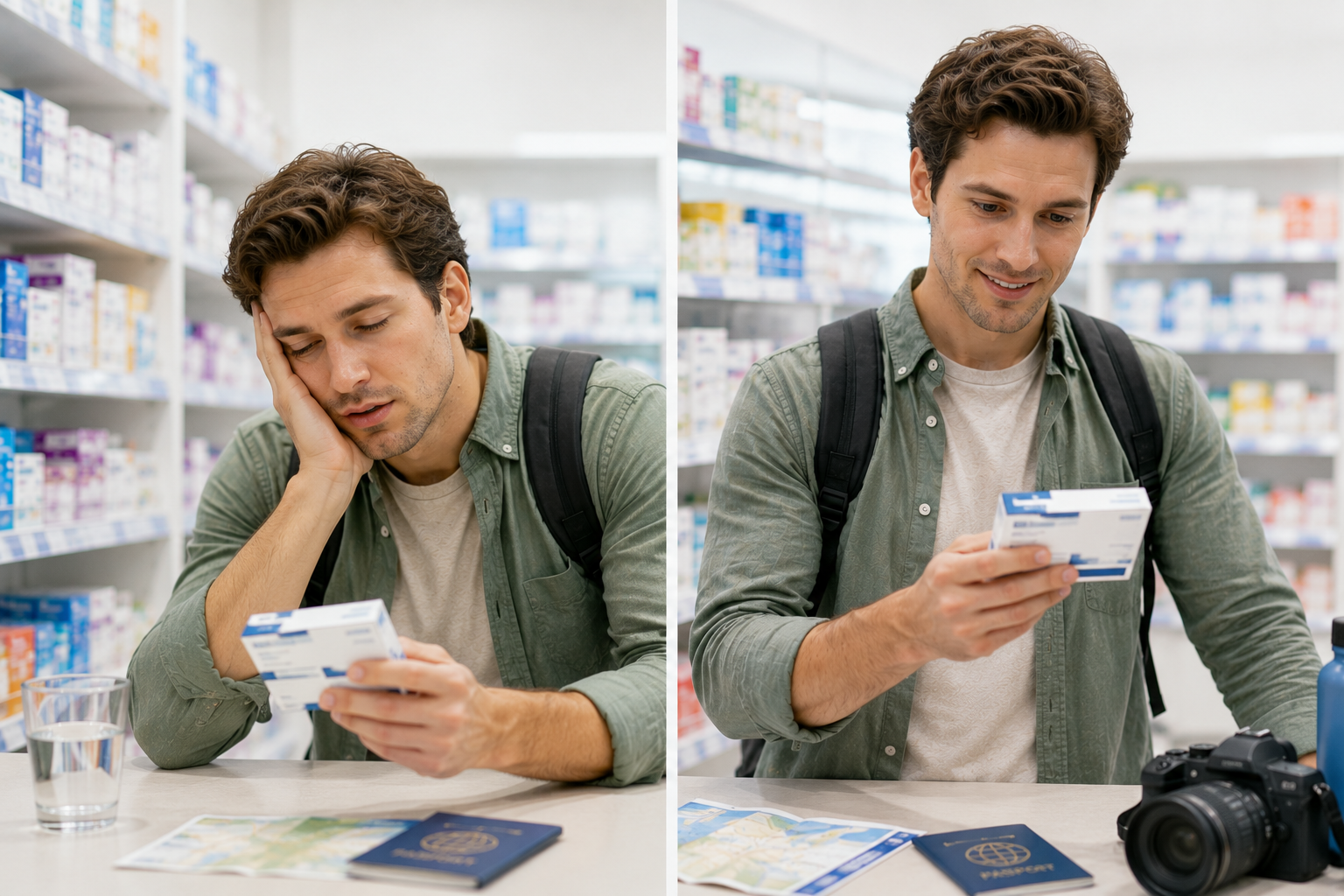
Allergy medicine in Japan may help with sneezing, runny nose, itchy nose, or watery eyes, but one practical question matters a lot when you are traveling:
Will this medicine make me sleepy?
This short guide explains how to check common antihistamine ingredient names on Japanese OTC labels. It is not a ranking of the “best” medicine and it does not recommend a specific product. Use the ingredient names as label clues, then ask a pharmacist or registered seller if the product fits your symptoms and plans for the day.
This article is general information for travelers and residents. It is not a diagnosis or a personal medicine recommendation.
- Quick Answer
- Why Drowsiness Matters During Travel
- Ingredients More Likely to Need Drowsiness Caution
- Ingredients Often Chosen When Drowsiness Is a Concern
- Do Not Combine Allergy and Cold Medicine Without Checking
- What to Ask at a Japanese Pharmacy
- When to Seek Medical Care
- Bottom Line
- Related Guides
- References
Quick Answer
If you need to avoid drowsiness, first look for the active ingredient name and the driving warning on the package or insert.
| Practical label clue | Ingredient names you may see |
| More drowsiness caution / do not assume safe for daytime travel | chlorpheniramine maleate, d-chlorpheniramine maleate, diphenhydramine hydrochloride, cetirizine hydrochloride, bepotastine besilate |
| Often marketed as less likely to cause drowsiness | fexofenadine hydrochloride, loratadine |
This is a practical travel checklist, not a perfect pharmacology ranking. Some “less drowsy” antihistamines can still cause drowsiness in some people. Some products may still say not to drive or operate machinery after taking them.
Why Drowsiness Matters During Travel
Drowsiness from antihistamines can affect more than sleepiness. It may affect:
- driving or cycling
- train transfers and airport movement
- work, study, or meetings
- alcohol use
- sleep medicine or sedative use
- older adults, children, or people taking other medicines
If you are sightseeing, driving, skiing, cycling, or moving between cities, choose carefully and ask before buying.
Ingredients More Likely to Need Drowsiness Caution
These ingredient names deserve extra attention on Japanese labels:
- chlorpheniramine maleate
- d-chlorpheniramine maleate
- diphenhydramine hydrochloride
- cetirizine hydrochloride
- bepotastine besilate
Chlorpheniramine and diphenhydramine are older antihistamines and are more strongly associated with drowsiness. They may also appear in cold medicines, runny nose medicines, sleep-related products, or combination products.
Cetirizine and bepotastine are newer antihistamines, but they should not be treated as automatically “no drowsiness.” Depending on the product and the person, drowsiness or driving caution may still matter.
Ingredients Often Chosen When Drowsiness Is a Concern
These names are useful to recognize if you are trying to avoid drowsiness:
- fexofenadine hydrochloride
- loratadine
In Japan, products containing fexofenadine or loratadine are commonly marketed as less likely to cause drowsiness. Still, the safer rule is:
Check the package, check the insert, and ask pharmacy staff if you need to drive, drink alcohol, or stay alert.
Do Not Combine Allergy and Cold Medicine Without Checking
Many Japanese cold medicines already contain an antihistamine for runny nose or sneezing. If you add a separate allergy medicine, you may accidentally double up.
Before combining products, ask:
- Does this cold medicine already contain an antihistamine?
- Will this duplicate my allergy medicine?
- Is it safe if I also take sleep medicine, sedatives, or alcohol?
This matters even more if the product is for a child, an older adult, a pregnant or breastfeeding person, or someone with glaucoma, urination problems, liver disease, kidney disease, or other chronic conditions.
What to Ask at a Japanese Pharmacy
You can show these short phrases:
| English meaning | Japanese to show |
| Does this medicine easily cause drowsiness? | この薬は眠くなりやすいですか? |
| Can I drive after taking this? | この薬を飲んだ後に運転しても大丈夫ですか? |
| I need something less likely to make me sleepy. | 眠くなりにくい薬を希望します。 |
| Does this contain an antihistamine? | これは抗ヒスタミン薬を含んでいますか? |
| I already took cold medicine. | すでに風邪薬を飲みました。 |
| Please check whether the ingredients overlap. | 成分が重なっていないか確認してください。 |
For a broader pharmacy phrase card, see: Show This at a Japanese Pharmacy: OTC Medicine Questions in English and Japanese.
When to Seek Medical Care
Do not treat every runny nose, rash, or swollen eye as simple allergy.
Consider medical care if you have:
- trouble breathing
- swelling of the lips, tongue, throat, face, or around the eyes
- severe hives or rapidly spreading rash
- high fever or strong body aches
- wheezing or asthma symptoms
- severe headache, facial pain, or stiff neck
- symptoms after a suspected food, medicine, or insect-sting reaction
- symptoms that are getting worse or not improving
If symptoms feel severe or urgent in Japan, call 119.
Bottom Line
For travelers in Japan, the simplest antihistamine check is:
- Find the active ingredient name.
- Check whether the package warns about drowsiness, driving, alcohol, or machinery.
- Avoid combining allergy medicine with cold medicine unless pharmacy staff confirms the ingredients do not overlap.
- If drowsiness matters, ask specifically for a product that is less likely to make you sleepy.
Related Guides
- Runny Nose and Allergy Medicine in Japan: Antihistamines, Nasal Sprays, and Decongestants
- Cold Medicine in Japan: What to Check Before Buying OTC Medicine
- Sleep Aid Medicine in Japan: OTC Sleep Medicine and Safety Checks
- Drugstore Basics in Japan: How to Buy OTC Medicine Safely
References
- Pharmaceuticals and Medical Devices Agency (PMDA). OTC medicine package insert search. https://www.pmda.go.jp/PmdaSearch/otcSearch/
- NHS. Antihistamines. https://www.nhs.uk/medicines/antihistamines/
- Allegra FX official product information. https://www.allegra.jp/
- Claritin EX official product information. https://brand.taisho.co.jp/claritin/product/
- Alesion official product information. https://www.ssp.co.jp/alesion/products/