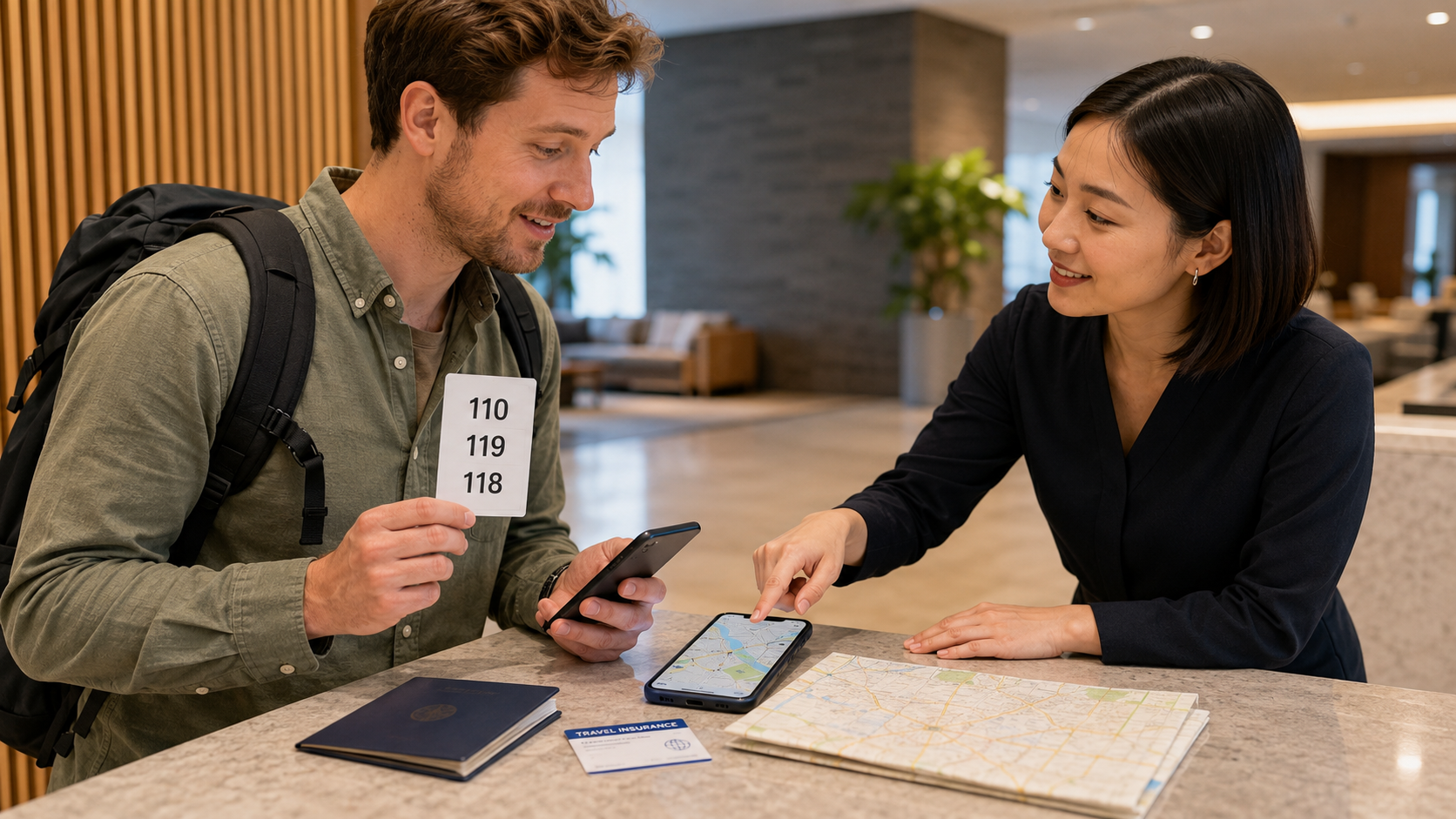
If you need urgent help in Japan, the quick answer is:
Call 119 for ambulance or fire, 110 for police, and 118 for accidents or incidents at sea. If you are not sure how to explain the situation, say “English please,” give your location first, and ask nearby hotel, station, restaurant, or store staff to help you call.
For tourist support in English, Chinese, or Korean, JNTO also lists the Japan Visitor Hotline: 050-3816-2787, available 24 hours a day. In a true emergency, call 119, 110, or 118 first.
Quick Emergency Number List
| Number | Use it for | Examples |
|---|---|---|
| 119 | Ambulance or fire | Serious illness, injury, collapse, severe allergic reaction, fire |
| 110 | Police | Crime, traffic accident, immediate danger, theft in progress |
| 118 | Japan Coast Guard | Accident or incident at sea, boat trouble, person in danger in the water |
| 050-3816-2787 | JNTO Japan Visitor Hotline | Tourist support, illness, disaster, language help, finding official information |
If someone is sick or injured on land, 119 is usually the number for ambulance help. If the emergency is at sea, on a boat, or in the water, 118 may be the right number.
What to Say First
When you call, the most important thing is your location. If you do not know the full address, give a hotel name, station name, store name, intersection, landmark, or map pin.
| English meaning | Japanese to show or say |
|---|---|
| Help, this is an emergency. | 助けてください。緊急です。 |
| Ambulance, please. | 救急車をお願いします。 |
| Police, please. | 警察をお願いします。 |
| There is a fire. | 火事です。 |
| English, please. | 英語でお願いします。 |
| I am a traveler. | 旅行者です。 |
| I am here now. | 今ここにいます。 |
| I do not know the address. | 住所がわかりません。 |
You can also show this sentence to someone nearby:
Please call an ambulance.
救急車を呼んでください。
Information to Prepare
The operator may ask questions in order. Stay calm and give short answers.
- Where are you now?
- What happened?
- When did it happen?
- How many people need help?
- Is anyone injured, unconscious, bleeding, having trouble breathing, or unable to move?
- What is your name and phone number?
If your mobile phone does not connect, ask nearby people or staff to call, try a public phone, or go to the nearest police box, station office, hotel front desk, store, or fire station if safe.
Which Number Should You Choose?
Call 119 if someone may need an ambulance or there is a fire. Examples include severe chest pain, trouble breathing, loss of consciousness, seizure, serious injury, heavy bleeding, severe allergic reaction, stroke-like symptoms, heat illness with confusion or fainting, or fire.
Call 110 if you need police urgently. Examples include a crime, violence, stalking, traffic accident, theft in progress, or immediate danger. For lost items or non-urgent police help, a nearby koban police box or police station may be more appropriate.
Call 118 for emergencies at sea. This can include a boating accident, someone in danger in the water, a marine accident, or suspicious activity at sea.
If you are unsure where to go for non-emergency medical care, see: Where Should I Go If I Feel Sick in Japan? Drugstore, Pharmacy, Clinic, Hospital, or 119
For medical payment and travel insurance basics, see: Medical Costs in Japan: What Travelers Should Know Before Seeing a Doctor
For restaurant allergy situations, see: Food Allergies in Japan: How Travelers Can Ask Restaurants Safely
Save These Before You Need Them
Before walking around Japan, it helps to save:
- your hotel name, address, and phone number
- your travel insurance assistance number
- your passport photo page copy
- your medicine list and allergy list
- Japan Visitor Hotline: 050-3816-2787
- the location of the nearest station, hotel, convenience store, or major landmark
In many real situations, the fastest step is to show your phone map and ask staff:
Please help me call 119 / 110.
119番 / 110番に電話するのを手伝ってください。
Small but Important Notes
This guide is for general travel safety information. Emergency services, language support, and local procedures can vary by area and situation.
If the situation feels urgent, do not spend time searching for the perfect article or phrase. Call the appropriate emergency number and ask someone nearby to help.
Summary
For travelers in Japan:
- 119 = ambulance or fire.
- 110 = police.
- 118 = Japan Coast Guard / sea emergencies.
- Give your location first.
- Say “English please” and ask nearby staff to help if needed.
Related Guides
- Where Should I Go If I Feel Sick in Japan?
- Medical Costs in Japan: What Travelers Should Know Before Seeing a Doctor
- Food Allergies in Japan: How Travelers Can Ask Restaurants Safely
- Lost or Forgot Prescription Medicine in Japan: What Travelers Should Do
References
- Japan National Tourism Organization. Japan Visitor Hotline. https://www.japan.travel/en/plan/hotline/
- Japan National Tourism Organization. Staying Safe in Japan. https://www.japan.travel/en/plan/emergencies/
- Fire and Disaster Management Agency. 119 emergency calls. https://www.fdma.go.jp/mission/enrichment/kyukyumusen_kinkyutuhou/119.html
- Tokyo Metropolitan Police Department. For Visitors to Tokyo. https://www.keishicho.metro.tokyo.lg.jp/multilingual/english/safe_society/victim_of_crime/ninpo.html
- Japan Coast Guard. Emergency number 118. https://www.kaiho.mlit.go.jp/info/joho/tel118.html