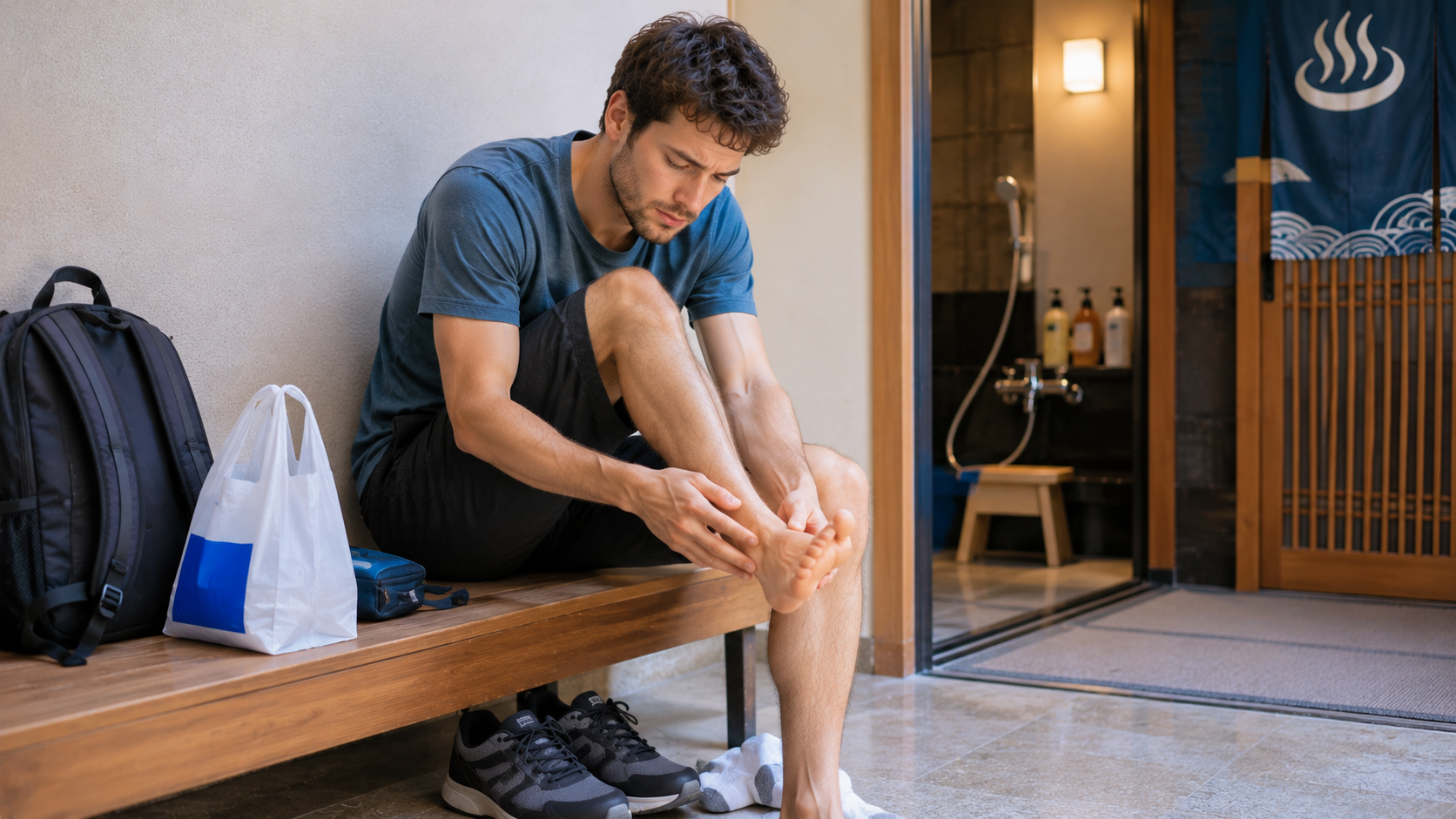
Itchy, peeling, cracked, or white skin between the toes can happen during travel in Japan, especially after long walking days, sweaty shoes, shared showers, pools, public baths, gyms, or humid weather. One possible cause is athlete’s foot, also called foot fungus or tinea pedis.
Japanese drugstores often sell OTC antifungal medicines for athlete’s foot. You may see creams, liquids, sprays, powders, and combination products. The most important point is this: choose the product for the correct condition, and check whether it is safe for your skin and your situation before using it.
This guide does not recommend a specific product. Ingredient names are label clues only. Ask a pharmacist or registered seller if you are not sure.
- Quick Guide: What to Check First
- Before You Buy: Check the “Do Not Use” Warnings
- Common Signs That May Suggest Athlete’s Foot
- Ingredient Names You May See on Japanese Antifungal Labels
- Cream, Liquid, Spray, or Powder: What Is the Difference?
- Do Not Use Steroid-Only Cream as a Guess
- Toenail Fungus Is Different
- How to Use OTC Antifungal Medicine Safely
- When to Ask for Medical Care Instead of Self-Treating
- How to Reduce Recurrence During Travel
- Useful Phrases to Show at a Japanese Pharmacy
- Related Guides
- References
Quick Guide: What to Check First
| Situation | What to check first |
| Itchy, peeling, white, or cracked skin between the toes | Athlete’s foot is possible. Check for an antifungal ingredient and ask pharmacy staff if the product matches your symptoms. |
| Thick, yellow, crumbly, or deformed toenails | This may be nail fungus. OTC skin creams may not be enough. Medical care may be needed. |
| Skin is very painful, hot, swollen, bleeding, oozing pus, or redness is spreading | This may be more than simple athlete’s foot. Consider medical care. |
| You have diabetes, poor circulation, a weakened immune system, or a serious skin wound | Ask a doctor or pharmacist before self-treating. Foot problems can become serious. |
| You are not sure whether it is athlete’s foot, eczema, contact dermatitis, an insect bite, or a bacterial infection | Do not guess with steroid-only cream. Ask pharmacy staff or seek medical care. |
In short: OTC antifungal medicine may help mild athlete’s foot, but the diagnosis matters. Foot symptoms are not always fungal.
Before You Buy: Check the “Do Not Use” Warnings
Every OTC athlete’s foot product in Japan has its own “do not use” and “ask before use” warnings. These warnings can differ by product because the antifungal ingredient, supporting ingredients, and dosage form are not always the same.
Before buying or using a product, check the label or package insert for warnings. Examples commonly seen in Japanese OTC athlete’s foot medicines include:
- do not use the product if you previously had rash, redness, itching, swelling, or other allergic-type symptoms from the product or its ingredients
- do not use it around the eyes, on mucous membranes such as the mouth, nose, or vagina, or on the scrotum or external genital area
- do not use it on eczema
- do not use it on severely wet, eroded, badly cracked, or seriously injured skin
- ask a pharmacist, registered seller, or doctor first if the user is an infant or young child, pregnant, receiving medical treatment, has pus, has symptoms over a wide area, or is not sure whether the problem is athlete’s foot or eczema
If symptoms get worse, spread, ooze, or do not improve after the period written on the label, stop using the product and ask for professional advice. Ingredient names are helpful, but the “do not use” section is just as important.
Common Signs That May Suggest Athlete’s Foot
Athlete’s foot often affects the space between the toes, but it can also affect the sole or side of the foot. Possible signs include:
- itching or burning between the toes
- white, soggy, peeling, or cracked skin
- dry, flaky, or scaly patches on the foot
- small blisters in some cases
- repeated symptoms that come back when the feet become sweaty or moist
These signs can overlap with other skin problems. Eczema, contact dermatitis, bacterial infection, insect bites, shoe irritation, and psoriasis can sometimes look similar. If the area is painful, spreading, infected-looking, or not improving, do not keep switching OTC products without advice.
Ingredient Names You May See on Japanese Antifungal Labels
This guide focuses on ingredient names that are commonly seen in Japanese OTC athlete’s foot medicines. It does not include prescription-only ingredients or ingredients that are not commonly found in OTC athlete’s foot products.
Japanese athlete’s foot products may contain antifungal ingredients such as:
- terbinafine hydrochloride
- butenafine hydrochloride
- lanoconazole
- clotrimazole
These names do not mean one product is automatically best for you. They are useful because they help you confirm that the product is an antifungal medicine, not just an itch cream or moisturizer.
Some products also contain ingredients for itching, inflammation, local discomfort, or secondary infection prevention. Those supporting ingredients do not replace the need for an antifungal ingredient when the problem is athlete’s foot.
Cream, Liquid, Spray, or Powder: What Is the Difference?
Japanese drugstores may sell several forms of athlete’s foot medicine.
Creams are often used for skin between the toes or areas that are dry, peeling, or cracked. They may be easier to apply directly to the affected skin.
Liquids may feel refreshing, but they can sting on cracked, raw, or broken skin. If the skin is split or painful, ask staff before choosing a liquid product.
Sprays can be convenient for wider areas or for people who do not want to touch the affected area directly. Still, the medicine needs to reach the affected skin.
Powders may help keep the feet dry, but powder alone may not be enough if an active fungal infection needs treatment. Some powders are used more for moisture control or prevention of recurrence.
The best form depends on where the symptoms are, whether the skin is wet or dry, and whether the skin is cracked or painful.
Do Not Use Steroid-Only Cream as a Guess
This is an important pharmacy point. If the problem is athlete’s foot, using a steroid-only cream may reduce redness or itching temporarily while allowing the fungal infection to continue or become harder to recognize.
Some skin products in Japan are for eczema, insect bites, or inflammation, not for athlete’s foot. If you think you have athlete’s foot, check that the product is actually an antifungal medicine.
If you already used a steroid cream and the rash changed, spread, or did not improve, ask a pharmacist or doctor.
Toenail Fungus Is Different
Athlete’s foot affects the skin. Toenail fungus affects the nail.
If your main problem is a thick, yellow, white, brown, crumbly, lifted, or deformed toenail, a regular OTC athlete’s foot cream may not solve it. Nail fungus often needs a different diagnosis and longer treatment. In many cases, medical care is more appropriate than buying another skin cream.
A useful pharmacy phrase is: “My toenail is thick and discolored. Is this something I should see a doctor for?”
How to Use OTC Antifungal Medicine Safely
Before using any OTC athlete’s foot medicine, check:
- who will use it
- where it will be applied
- whether the skin is broken, bleeding, or oozing
- whether the symptom is on the skin or the nail
- whether the product is safe for children, pregnancy, breastfeeding, or existing illness
- whether you have had an allergy to similar medicines
- how many times per day to apply it
- how long to continue using it
- when to stop and ask for medical care
Do not apply the product to the eyes, mouth, mucous membranes, deep wounds, or areas not listed on the label. Do not use multiple creams at the same time unless pharmacy staff tells you it is appropriate.
Many athlete’s foot medicines need to be used for a period of time even after itching improves. Stopping too early can make symptoms return. Follow the product label or staff instructions.
When to Ask for Medical Care Instead of Self-Treating
Consider medical care, or ask pharmacy staff urgently, if:
- your foot or leg is hot, red, swollen, or very painful
- redness is spreading
- there is pus, bleeding, a bad smell, or an open wound
- you have fever or feel very unwell
- you have diabetes, poor circulation, or a weakened immune system
- symptoms involve the nail rather than only the skin
- symptoms spread to the hands, groin, or other body areas
- symptoms do not improve after using an appropriate OTC antifungal product as directed
- you are not sure whether it is athlete’s foot
If the situation feels severe or urgent, ask nearby staff for help or call 119 in Japan.
If you are not sure how to find medical care in Japan, see our guide: How to See a Doctor in Japan as a Traveler.
How to Reduce Recurrence During Travel
Medicine is only one part of athlete’s foot care. Moisture control matters.
During travel, try to:
- dry between your toes after bathing or showering
- change socks daily, or more often if sweaty
- let shoes dry when possible
- avoid sharing towels, socks, or shoes
- wear sandals or slippers in shared shower areas when appropriate
- avoid scratching the affected area
- wash hands after touching the affected foot
If symptoms keep coming back, it may be worth checking shoes, socks, toenails, and shared wet areas as possible sources of recurrence.
Useful Phrases to Show at a Japanese Pharmacy
| What you mean | Japanese to show |
| I think I may have athlete’s foot. | 水虫かもしれません。 |
| The skin between my toes is itchy and peeling. | 足の指の間がかゆくて、皮がむけています。 |
| The skin is cracked and painful. | 皮膚が割れて痛いです。 |
| I am looking for an antifungal medicine for athlete’s foot. | 水虫用の抗真菌薬を探しています。 |
| Is this product suitable for this symptom? | この症状にこの薬は使えますか? |
| The skin is broken / bleeding / oozing. | 皮膚が切れています/出血しています/じゅくじゅくしています。 |
| My toenail is thick and discolored. | 足の爪が厚く、色が変わっています。 |
| Should I see a doctor instead of using OTC medicine? | 市販薬ではなく、受診した方がよいですか? |
| I have diabetes / poor circulation / a weakened immune system. | 糖尿病があります/血流が悪いと言われています/免疫が低下しています。 |
Related Guides
You may also want to read:
- Skin Rash and Itching Medicine in Japan: OTC Creams and Safety Checks
- Insect Bite and Itching Medicine in Japan: OTC Creams and Safety Checks
- Drugstore Basics in Japan: How to Buy OTC Medicine Safely
- Show This at a Japanese Pharmacy: OTC Medicine Questions in English and Japanese
- How to See a Doctor in Japan as a Traveler
References
- NHS. Athlete’s foot.
- Pharmaceuticals and Medical Devices Agency (PMDA). OTC medicine package insert search.
- Hisamitsu Pharmaceutical. Butenalock V-alpha cream product information and precautions.
- Daiichi Sankyo Healthcare. Piroace Z cream product information and precautions.
- Daiichi Sankyo Healthcare. Piroace W cream product information and precautions.