If you are confused at a Japanese drugstore, the quick answer is:
OTC medicines in Japan are not all sold the same way. Some can be sold by a pharmacist or registered seller, some require a pharmacist, some require face-to-face guidance, and prescription medicines usually cannot be bought OTC. If staff ask questions or say the pharmacist is not available, it is usually because of Japan’s medicine sales rules, not because you did something wrong.
Quick Guide: What the Labels Mean
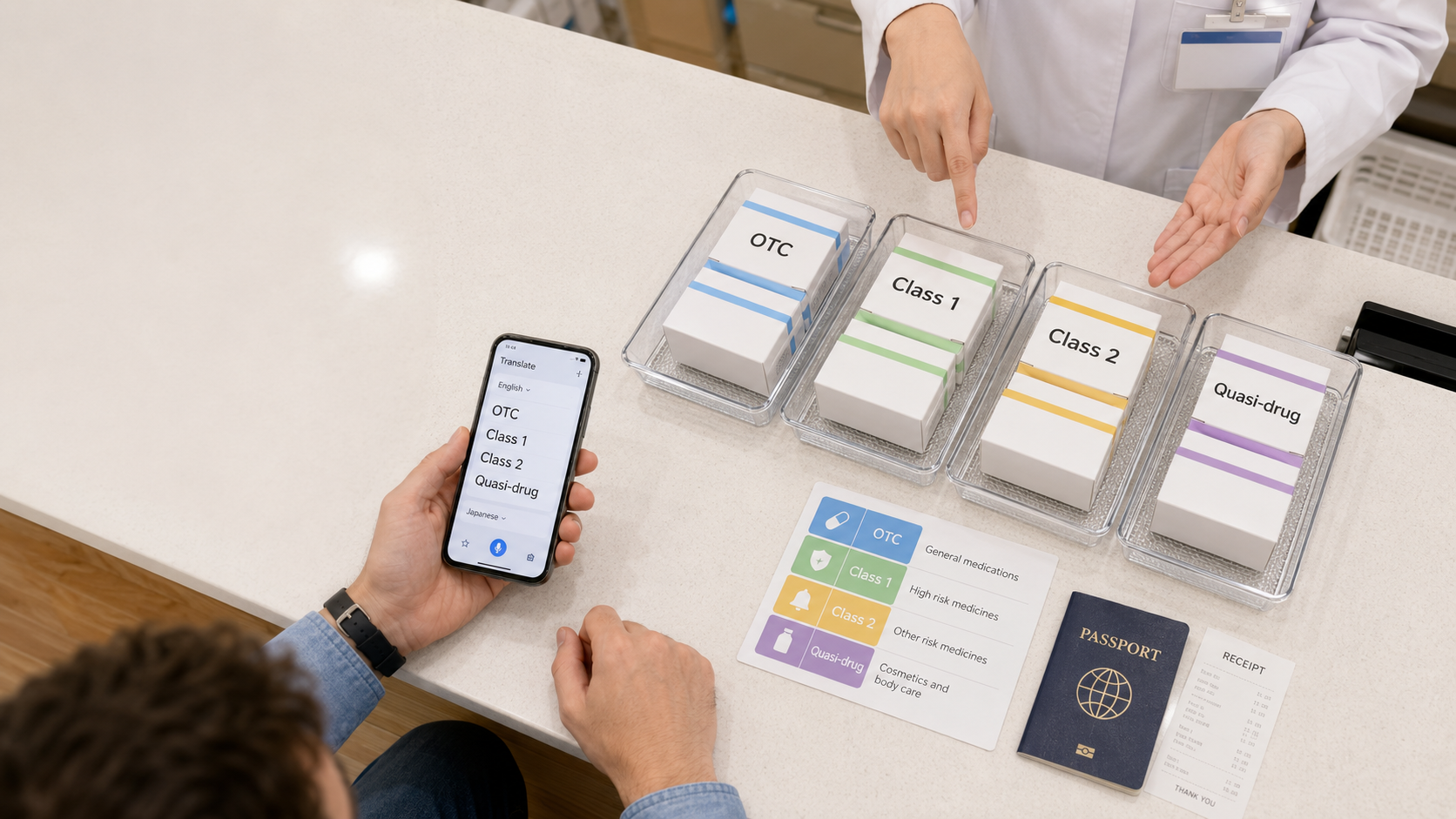
| Japanese category | Simple meaning for travelers | What may happen at the store |
|---|---|---|
| 要指導医薬品 | Guidance-required medicine | Pharmacist guidance is needed, usually face-to-face |
| 第1類医薬品 | Class 1 OTC medicine | Pharmacist information is required; you may need to wait |
| 指定第2類医薬品 | Designated Class 2 OTC medicine | Sold by pharmacist or registered seller, but needs extra caution |
| 第2類医薬品 | Class 2 OTC medicine | Sold by pharmacist or registered seller |
| 第3類医薬品 | Class 3 OTC medicine | Sold by pharmacist or registered seller; generally lower risk than Class 1 or 2 |
| 医薬部外品 | Quasi-drug | Not the same as an OTC medicine; often milder health or hygiene products |
The category is usually printed on the package in Japanese. If you cannot read it, show the box to staff and ask:
What class is this medicine?
この薬は何類ですか?
Why Some Medicine Is Behind the Counter
Some Japanese OTC medicines are not placed where customers can freely pick them up. This can happen because:
- a pharmacist must explain important points
- staff need to confirm who will use it
- the medicine may have stronger precautions
- the store may limit purchase quantity
- the pharmacist may not be working at that time
For example, some pain relievers, allergy medicines, stomach medicines, cold medicines, and motion sickness medicines may have different rules depending on their ingredients and product class.
Pharmacist vs Registered Seller
In Japan, both pharmacists and registered sellers may help with OTC medicines, but they are not the same.
- A pharmacist can handle all OTC categories, including Class 1 medicines and guidance-required medicines.
- A registered seller can sell many OTC medicines, such as Class 2 and Class 3, but not Class 1 medicines.
This is why a store can be open, but a specific medicine may not be available if the pharmacist is absent.
Why Staff May Ask Questions
Staff may ask about:
- your age
- symptoms
- who will use the medicine
- allergies
- pregnancy or breastfeeding
- other medicines you take
- how many packages you want
- whether you used the medicine before
Since May 1, 2026, Japan has also strengthened rules for some OTC medicines with abuse-prevention concerns. For certain products, staff may need to check age, purpose, quantity, or repeated purchases more carefully.
These questions are part of the sales system. You can answer simply and show a translation app if needed.
Useful Phrases at the Drugstore
| English meaning | Japanese to show |
|---|---|
| Is a pharmacist needed to buy this? | これは薬剤師が必要ですか? |
| Can I buy this now? | 今これを買えますか? |
| I am a traveler. | 旅行者です。 |
| This is for me. | 自分が使います。 |
| I have this symptom. | この症状があります。 |
| I take these medicines. | この薬を飲んでいます。 |
| I have this allergy. | このアレルギーがあります。 |
Prescription Medicines Are Different
Some medicines that are OTC in your home country may be prescription-only, unavailable, or sold in a different form in Japan. Antibiotics, many controlled medicines, many chronic disease medicines, and many injectable medicines cannot simply be bought at a drugstore.
If you lost or forgot your prescription medicine in Japan, see: Lost or Forgot Prescription Medicine in Japan: What Travelers Should Do
For basic shopping steps, see: Drugstore Basics in Japan: How to Buy OTC Medicine Safely
Summary
If you cannot buy a medicine in Japan, the reason may be:
- it requires a pharmacist
- it requires face-to-face guidance
- it is sold only under certain conditions
- the store is limiting quantity or checking use
- it is prescription-only in Japan
The easiest approach is to show the package, explain your symptom briefly, and ask whether a pharmacist is available.
Related Guides
- Drugstore Basics in Japan
- Where Should I Go If I Feel Sick in Japan?
- Lost or Forgot Prescription Medicine in Japan
- Which Loxonin S Should I Buy in Japan?
- Emergency Numbers in Japan
References
- Ministry of Health, Labour and Welfare. Medicine sales system. https://www.mhlw.go.jp/stf/seisakunitsuite/bunya/0000082514.html
- Ministry of Health, Labour and Welfare. Overview of the May 1, 2026 medicine sales system revision. https://www.mhlw.go.jp/stf/web_magazine/closeup/20.html
- Ministry of Health, Labour and Welfare. OTC medicine misuse and sales information. https://www.mhlw.go.jp/stf/seisakunitsuite/bunya/index_00033.html
- Ministry of Health, Labour and Welfare job tag. Registered seller role. https://shigoto.mhlw.go.jp/User/Occupation/Detail/448
- PMDA. Adverse reaction search category page for guidance-required and OTC medicine classes. https://www.info.pmda.go.jp/fsearchnew/jsp/menu_fukusayou_kensaku.jsp