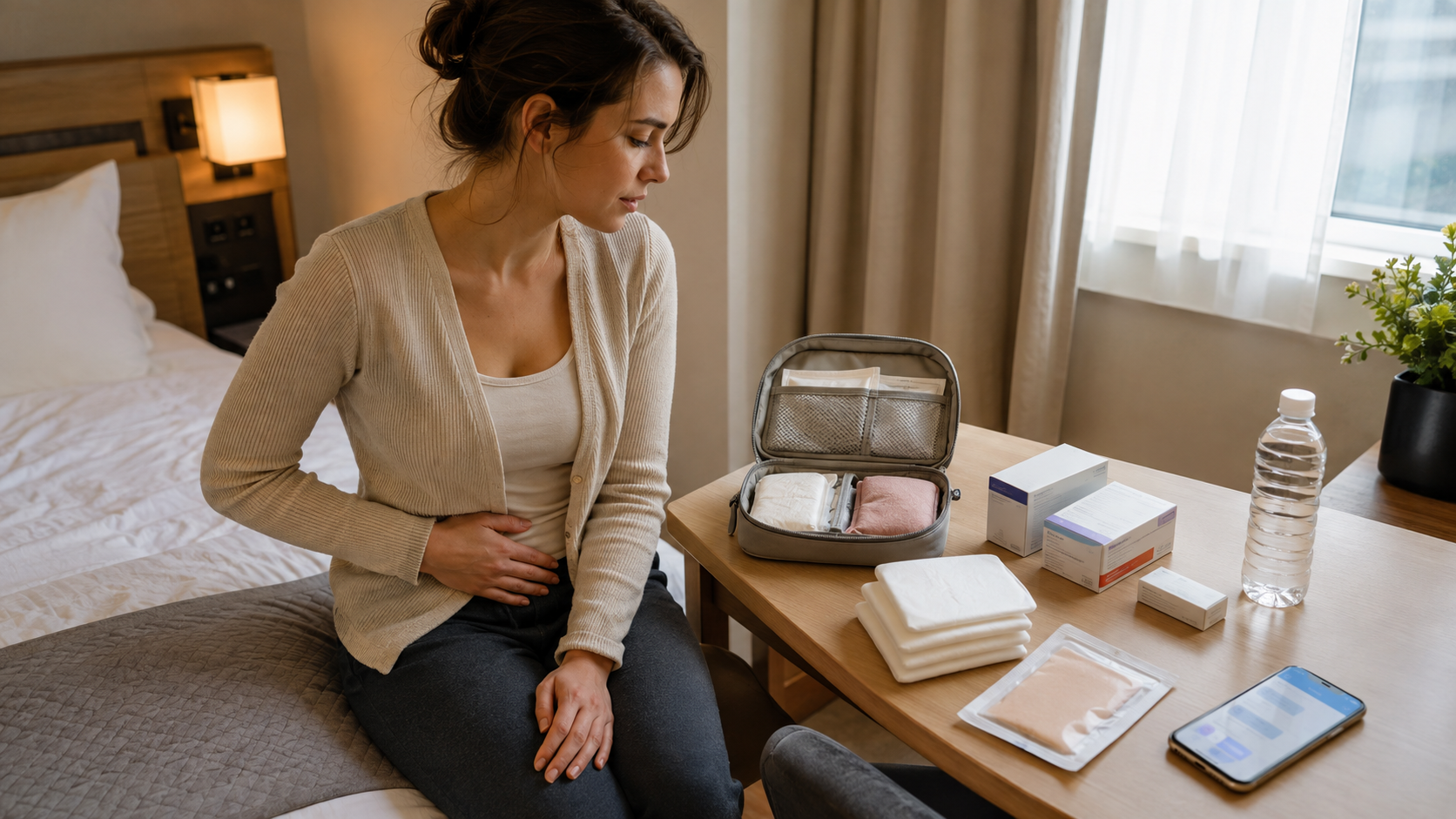
If period pain starts during your trip in Japan, the quick answer is:
At Japanese drugstores, period pain may be described as 生理痛. You may see oral pain relievers, heat patches, disposable warmers called kairo, sanitary products, and comfort items.
Before taking medicine, check the active ingredient, age limit, drowsiness warning, pregnancy/breastfeeding warnings, and any medicine you already took. Do not choose only by brand name or package color.
This article is a quick guide for travelers. It does not recommend one product for everyone.
Quick Guide: What to Check First
| Situation | What to check |
|---|---|
| Mild period cramps | Ask about an OTC pain reliever and check the active ingredient |
| You already took cold, headache, or fever medicine | Check for duplicate acetaminophen, ibuprofen, loxoprofen, aspirin-type ingredients, caffeine, or drowsy ingredients |
| You want to avoid drowsiness | Ask whether the product contains a sedative-related ingredient |
| You want warmth for cramps | Ask about a heat patch or disposable warmer, and check burn precautions |
| You may be pregnant or are breastfeeding | Ask pharmacy staff before using pain medicine or heat products |
| Pain is severe, unusual, one-sided, worsening, or with heavy bleeding or fever | Consider medical care instead of only OTC medicine |
OTC Pain Relievers You May See in Japan
Many Japanese products for period pain are the same general type as headache or fever medicines. The package may say period pain, headache, pain relief, or 鎮痛薬, but the active ingredient matters more than the marketing phrase.
Common ingredient names include:
- acetaminophen: used for pain and fever; check overlap with cold or fever medicine
- ibuprofen: an NSAID pain reliever; often used in Japanese pain-relief products
- loxoprofen: an NSAID pain reliever; oral OTC loxoprofen products are first-class OTC medicines in Japan and require pharmacist confirmation
- some aspirin-type or other NSAID ingredients: may appear in some pain relievers; check stomach, bleeding, asthma, age, and pregnancy cautions
Some combination products may also contain caffeine, stomach-support ingredients, or sedative-related ingredients. This can be useful for some people, but it also means you should check whether the medicine may cause drowsiness. If you want to ask about this in Japanese, the useful phrase is 眠くなる成分, meaning an ingredient that may make you sleepy.
For product-series comparisons, see:
- Which EVE Pain Reliever Should I Buy in Japan?
- Which Bufferin Should I Buy in Japan?
- Which Loxonin S Should I Buy in Japan?
Heat Patches and Disposable Warmers
Warmth may help some people feel more comfortable during period cramps. In Japan, you may see disposable warmers called kairo (カイロ), heat patches, warming pads, or 温熱シート.
These are usually comfort items, not medicine for the cause of pain. Check:
- whether the product can be used on clothing or directly on skin
- how long it can be used
- whether it should be used while sleeping
- whether it is safe for the lower abdomen
- whether you have diabetes, poor circulation, reduced skin sensation, or fragile skin
Stop using a heat product if the skin becomes red, painful, itchy, or burning. Low-temperature burns can happen when heat stays on the same area for a long time.
What to Tell Pharmacy Staff
Before buying period pain medicine in Japan, tell pharmacy staff:
- your age
- whether you may be pregnant or are breastfeeding
- what medicine you already took today
- whether you have stomach ulcer history, asthma from pain medicine, kidney disease, liver disease, heart disease, bleeding problems, or allergies
- whether you take blood thinners, prescription medicine, sleep medicine, antidepressants, or other regular medicine
- whether you need to drive, cycle, hike, ski, drink alcohol, or stay alert after taking it
For a broader safety checklist, see: Can I Combine Japanese OTC Medicines?
Useful Japanese Phrases
| English meaning | Japanese to show |
|---|---|
| I have period pain. | 生理痛があります。 |
| I am looking for medicine for period cramps. | 生理痛の薬を探しています。 |
| Does this contain acetaminophen / ibuprofen / loxoprofen? | これはアセトアミノフェン/イブプロフェン/ロキソプロフェンを含んでいますか? |
| Does this medicine make people sleepy? | この薬は眠くなる成分が入っていますか? |
| I already took cold medicine / headache medicine today. | 今日はすでに風邪薬/頭痛薬を飲みました。 |
| I may be pregnant. | 妊娠している可能性があります。 |
| I am breastfeeding. | 授乳中です。 |
| Can I use this heat patch on my lower abdomen? | この温熱パッチは下腹部に使えますか? |
| Should I see a doctor instead? | 市販薬ではなく受診した方がよいですか? |
When to Consider Medical Care
Period pain can be common, but do not rely only on OTC medicine if symptoms are severe or unusual.
Consider a clinic or hospital if you have severe pain, pain that is much worse than usual, heavy bleeding, dizziness or fainting, fever, unusual discharge, possible pregnancy with pain or bleeding, one-sided strong lower abdominal pain, pain after injury, or symptoms that do not improve.
If symptoms feel urgent in Japan, call 119.
Bottom Line
For period pain in Japan, start by checking the active ingredient, not only the brand name. Pain relievers, cold medicines, headache medicines, and fever medicines can overlap. Heat patches may help with comfort, but check burn precautions carefully.
If you are unsure, show the package and your situation to pharmacy staff before using it.
Related Guides
- Drugstore Basics in Japan
- Loxoprofen vs Acetaminophen in Japan
- Which EVE Pain Reliever Should I Buy in Japan?
- Which Bufferin Should I Buy in Japan?
- Which Loxonin S Should I Buy in Japan?
- Can I Combine Japanese OTC Medicines?
- How to See a Doctor in Japan as a Traveler
References
- NHS. Period pain. https://www.nhs.uk/symptoms/period-pain/
- NHS. Period problems. https://www.nhs.uk/conditions/periods/period-problems/
- PMDA. OTC and guidance-required medicine package insert search. https://www.pmda.go.jp/PmdaSearch/otcSearch/
- Consumer Affairs Agency, Government of Japan. Burns from heating products and low-temperature burn cautions. https://www.caa.go.jp/policies/policy/consumer_safety/child/project_001/mail/20221128/