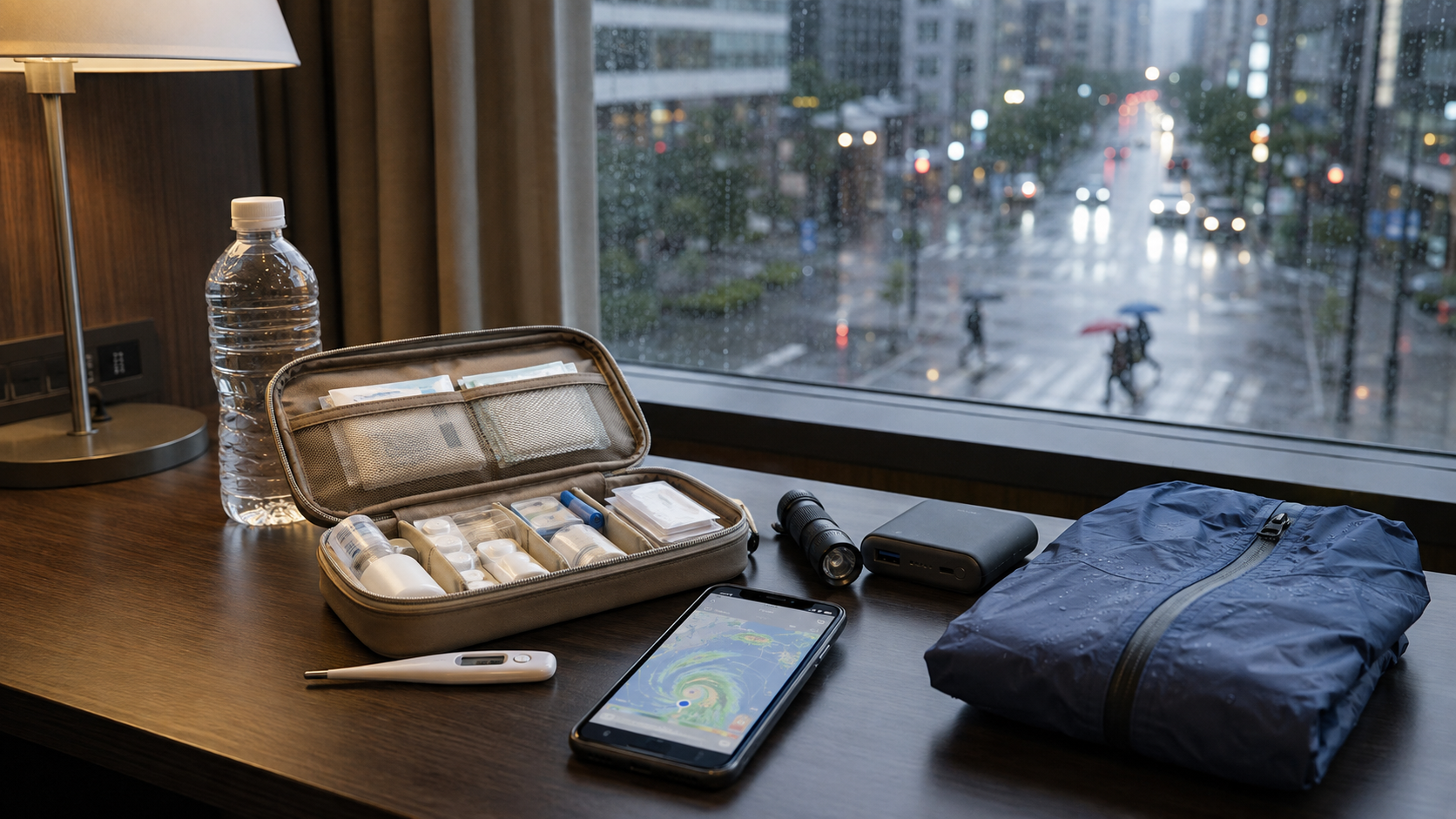
If you are traveling in Japan during typhoon season, the quick answer is:
Do not wait until the storm is close to check your medicine. Keep at least 2-3 days of prescription medicine with you, prepare a small OTC kit, and check official weather and transport information before delays or store closures happen.
At a Japanese drugstore, ask about active ingredients, duplicate medicines, drowsiness, age limits, and whether a pharmacist is available. Some OTC medicines cannot be sold when the pharmacist is not there.
Typhoon season is not only a weather problem. For travelers, it can also affect pharmacy access, clinic visits, transport to medical care, and how safely you can manage symptoms.
- First: The 3 Things to Check
- Quick Health and Medicine Checklist
- Pharmacist-Style Medicine Checks Before the Storm
- Buying OTC Medicine During a Typhoon
- Hydration and Heat Still Matter
- When to Seek Medical Care
- Official Information to Check Early
- Useful Japanese Phrases
- Bottom Line
- Related Guides
- Sources Checked
First: The 3 Things to Check
| Check first | What it means |
|---|---|
| Medicine | Keep prescription medicine close, check generic names, and avoid duplicate OTC ingredients |
| Medical access | Know whether your symptoms can wait, need a clinic, or may need 119 |
| Official information | Check JMA, Safety tips, Japan Safe Travel, transport companies, and your hotel |
Quick Health and Medicine Checklist
| Prepare this | Why it matters during a typhoon |
|---|---|
| Prescription medicine for at least 2-3 days | Trains, flights, buses, and clinics may be disrupted |
| Medicine list or photo of labels | Helps pharmacy staff or doctors understand what you use |
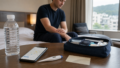
| Basic OTC items | Fever/pain, stomach, allergy, and wound-care items may help, but check duplicate ingredients |
| Oral rehydration product or bottled water | Heat, sweating, vomiting, diarrhea, or long waits can increase dehydration risk |
| Thermometer | Helps explain fever clearly at a pharmacy or clinic |
| Bandages and antiseptic wipes | Useful for small cuts after rain, slips, or travel delays |
| Phone battery and official apps/sites | Weather, transport, medical access, and emergency information can change quickly |
| Travel insurance information | Medical care may be costly without coverage |
For basic drugstore navigation, see: Drugstore Basics in Japan
Pharmacist-Style Medicine Checks Before the Storm
Before a typhoon gets close, check these points:
- Do you have at least 2-3 days of prescription medicine with you?
- Are medicines kept in the original package or do you have a photo of the label?
- Do you know the generic name, not only the brand name from your home country?
- Do you already have fever, pain, cold, stomach, or allergy medicine with overlapping ingredients?
- Will any medicine make you sleepy during evacuation, train changes, or travel decisions?
- Does your medicine need refrigeration or special storage?
If you lost or forgot prescription medicine, do not wait until trains stop or clinics close. Read: I Lost or Forgot My Prescription Medicine in Japan
Buying OTC Medicine During a Typhoon
Japanese drugstores may stay open, shorten hours, or close depending on local conditions. Pharmacies inside clinics may also be affected.
Also remember that some OTC medicines need pharmacist involvement. The store itself may be open, but certain medicines may not be available if the pharmacist is not present.
Examples include some Class 1 OTC medicines and guidance-required medicines. For example, oral loxoprofen products for pain or fever generally require pharmacist confirmation in Japan.
When buying medicine, do not choose only by package color or brand. Check:
- active ingredient
- age limit
- drowsiness warning
- pregnancy or breastfeeding cautions
- alcohol warning
- duplicate ingredients with cold, headache, fever, or pain medicine
- whether your chronic conditions or regular medicines matter
For duplicate medicine checks, see: Can I Combine Japanese OTC Medicines?
Hydration and Heat Still Matter
Even during typhoon season, September in Japan can still be hot and humid. Long walks, crowded stations, delayed trains, and poor fluid intake can make travelers feel worse.
If you are sweating heavily, vomiting, having diarrhea, or waiting a long time without easy access to drinks, hydration matters. Oral rehydration products may be useful in some situations, but people with kidney disease, heart disease, high blood pressure, diabetes, or salt/fluid restrictions should ask a healthcare professional first.
For more detail, see: Oral Rehydration Products in Japan
When to Seek Medical Care
Do not rely only on OTC medicine if symptoms are severe, unusual, or getting worse.
Seek medical care or call 119 if you have:
- chest pain, severe shortness of breath, or loss of consciousness
- severe injury, heavy bleeding, or possible fracture
- confusion, fainting, severe weakness, or inability to drink
- repeated vomiting or signs of dehydration
- high fever with stiff neck, rash, severe headache, or worsening condition
- severe abdominal pain
- symptoms that feel urgent during a storm or evacuation
For emergency phone numbers, see: Emergency Numbers in Japan
For non-emergency care, see: How to See a Doctor in Japan as a Traveler
Official Information to Check Early
During typhoon season, check official or reliable sources instead of only social media.
Useful sources include:
- Japan Meteorological Agency weather warnings and advisories
- Japan Meteorological Agency tropical cyclone information
- Safety tips Web for disaster information in multiple languages
- Japan Safe Travel information from JNTO
- Japan Visitor Hotline: 050-3816-2787 in Japan, or +81-50-3816-2787 from overseas
- your airline, rail company, hotel, and local government websites
Useful Japanese Phrases
| English meaning | Japanese to show |
|---|---|
| A typhoon is approaching. | 台風が近づいています。 |
| I need several days of medicine. | 数日分の薬が必要です。 |
| I take this prescription medicine regularly. | この処方薬を普段から飲んでいます。 |
| Is a pharmacist available now? | 今、薬剤師さんはいますか? |
| Can I take this with my other medicine? | これは他の薬と一緒に飲めますか? |
| Does this medicine make people sleepy? | この薬は眠くなる成分が入っていますか? |
| I may be dehydrated. | 脱水かもしれません。 |
| I need medical care. | 受診が必要です。 |
| Please call an ambulance. | 救急車を呼んでください。 |
Bottom Line
Before a typhoon in Japan, prepare medicine the same way you prepare transport and hotel plans. Keep at least 2-3 days of prescription medicine close, check OTC ingredients carefully, ask whether a pharmacist is available, and use official weather and emergency information.
If symptoms are serious or travel disruption makes self-care unsafe, seek medical care rather than waiting for the storm to pass.
Related Guides
- Drugstore Basics in Japan
- I Lost or Forgot My Prescription Medicine in Japan
- Can I Combine Japanese OTC Medicines?
- Oral Rehydration Products in Japan
- Emergency Numbers in Japan
- How to See a Doctor in Japan as a Traveler
- Medical Costs and Travel Insurance in Japan
Sources Checked
- Japan National Tourism Organization. Japan in September. https://faq.japan-travel.jnto.go.jp/en/guide/september/
- Japan Meteorological Agency. Weather warning / advisory. https://www.data.jma.go.jp/multi/warn/index.html?lang=en
- Japan Meteorological Agency. Tropical Cyclone Information. https://www.data.jma.go.jp/multi/cyclone/index.html?lang=en
- JNTO. Japan Visitor Hotline. https://www.japan.travel/en/plan/hotline/
- Japan Tourism Agency. Safety tips Web. https://safetytips-web.rcsc.co.jp/useful_information?lang=en
- JNTO. Guide for when you are feeling ill in Japan. https://www.jnto.go.jp/emergency/eng/mi_guide.html
- Ministry of Health, Labour and Welfare. Guidance-required and OTC medicine information. https://www.mhlw.go.jp/stf/seisakunitsuite/bunya/0000092787.html