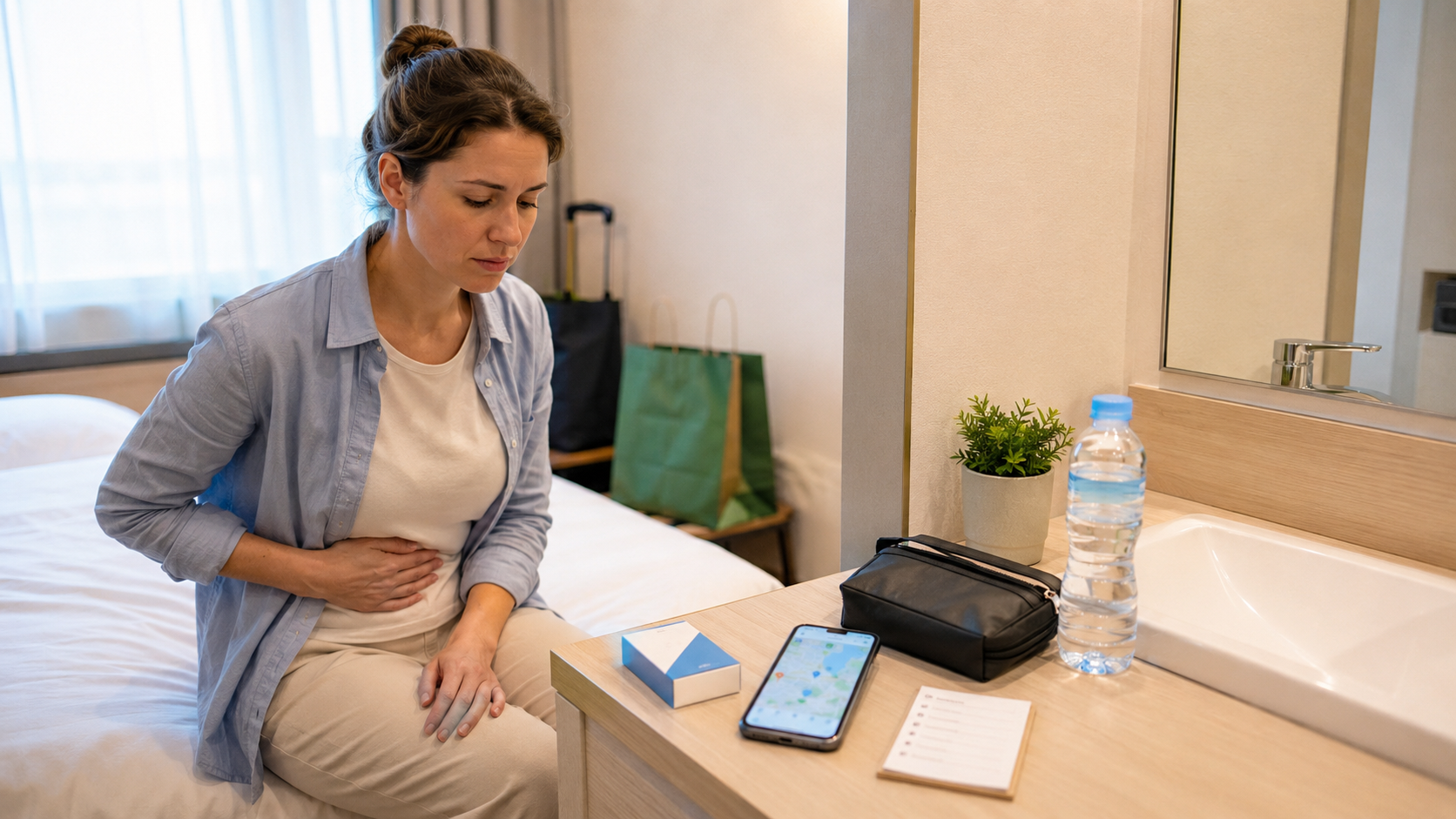
If you have pain or burning when you pee, frequent urination, sudden urgency, or lower belly discomfort in Japan, you may be thinking about a UTI, cystitis, or bladder infection. In Japanese, cystitis is often called 膀胱炎.
Quick answer: a Japanese drugstore may help you check OTC options for mild urinary discomfort, but oral antibiotics used to treat UTIs usually require a doctor’s prescription in Japan.
If symptoms do not improve quickly, or if you strongly suspect a UTI, a clinic is safer than repeated OTC self-care.
If you have fever, chills, back or side pain, nausea, vomiting, blood in urine, pregnancy, symptoms in men, diabetes, immune problems, severe pain, or symptoms that are getting worse, look for a clinic instead of relying only on a drugstore.
For urinary symptoms, useful clinic departments include urology (泌尿器科), internal medicine (内科), and sometimes gynecology or obstetrics/gynecology (婦人科 / 産婦人科).
This article is a quick traveler guide. It is not a diagnosis.
- Quick Check: Drugstore or Clinic?
- Can You Buy Antibiotics for a UTI in Japan?
- OTC Products You May See at Japanese Drugstores
- Symptoms That Sound Like Cystitis or UTI
- What a Drugstore Can and Cannot Do
- Which Clinic Should You Look For?
- Useful Japanese Phrases
- When to Seek Urgent Help
- Bottom Line
- Related Guides
- References
Quick Check: Drugstore or Clinic?
| Situation | Better first step |
|---|---|
| Mild burning or frequent urination, no fever, otherwise well | A drugstore may help with OTC questions, but monitor closely |
| Symptoms continue, worsen, or return quickly | Visit a clinic |
| Fever, chills, back or side pain, nausea, or vomiting | Visit a clinic promptly; kidney infection is possible |
| Blood in urine | Visit a clinic |
| Pregnant or possibly pregnant | Contact obstetrics/gynecology or a clinic |
| Male traveler with UTI-like symptoms | Visit urology or internal medicine |
| Genital discharge, sores, pelvic pain, testicular pain, or possible STI exposure | Visit a clinic |
| Child, older adult, diabetes, catheter, kidney disease, or immune problems | Seek medical advice early |
| Cannot urinate, severe pain, confusion, or very unwell feeling | Seek urgent care or call 119 |
Can You Buy Antibiotics for a UTI in Japan?
In most cases, no. Oral antibiotics used to treat UTIs are usually prescription medicines in Japan. A doctor usually needs to examine you and decide whether a urine test or antibiotic is needed.
At a drugstore, you may see products marketed for urinary discomfort, bladder symptoms, herbal formulas, or Kampo-style support. These products are not the same as antibiotics. Do not assume they can cure a bacterial UTI.
OTC Products You May See at Japanese Drugstores
You may see Japanese OTC products for cystitis-like symptoms or urinary discomfort. This section is not a recommendation to buy one specific product. It is a quick label-reading guide for travelers.
| Product or formula you may see | Type | What to know |
|---|---|---|
| Boukoren / ボーコレン | Kampo-based OTC medicine using Gorinsan / 五淋散 | Marketed for symptoms such as frequent urination, painful urination, residual urine feeling, and cloudy urine. It is not an oral antibiotic. |
| Boukoren Age+ / ボーコレンエージ+ | Kampo-based OTC medicine using Choreito-go-Shimotsuto / 猪苓湯合四物湯 | A related Boukoren product for urinary symptoms. Check the exact package because the formula is different from regular Boukoren. |
| Jinsensan / 腎仙散 | Crude-drug / herbal OTC medicine | Marketed for cystitis-related symptoms and urinary problems. It is not the same as an oral antibiotic for bacterial UTI. |
| Other Kampo urinary formulas / 猪苓湯など | Kampo-style urinary symptom products | Some products are sold for urinary discomfort patterns, but the right choice depends on symptoms, age, pregnancy status, and health conditions. |
Many urinary symptom products in Japan are Class 2 OTC medicines. They can still have important cautions, especially for pregnancy, kidney disease, heart disease, high blood pressure, older adults, stomach sensitivity, diarrhea, allergies, or regular medicines.
Do not keep repeating OTC urinary products during your trip if symptoms continue, worsen, or come back quickly. A clinic may be needed.
Ask pharmacy staff to check:
- the active ingredient
- the indication on the package
- age limits
- pregnancy and breastfeeding warnings
- allergies
- interactions with your regular medicines
- whether your symptoms sound better suited for a clinic
For general drugstore basics, see: Drugstore Basics in Japan
Symptoms That Sound Like Cystitis or UTI
Common UTI-like symptoms include:
- pain or burning when urinating
- needing to urinate more often than usual
- sudden urgency
- feeling like urine remains after peeing
- lower belly pressure or discomfort
- cloudy urine, strong-smelling urine, or blood in urine
Japanese keywords you may see or use:
| English | Japanese |
|---|---|
| cystitis / bladder infection | 膀胱炎 |
| pain when urinating | 排尿痛 |
| frequent urination | 頻尿 |
| feeling urine remains | 残尿感 |
| blood in urine | 血尿 |
| back pain | 背中の痛み |
| side/flank pain | わき腹の痛み |
What a Drugstore Can and Cannot Do
A Japanese drugstore can help you:
- check whether an OTC product matches the symptoms written on the package
- avoid duplicate ingredients with pain, fever, cold, or stomach medicine
- check drowsiness warnings and age limits
- ask whether a pharmacist is available
- decide whether a clinic is safer
A drugstore cannot diagnose a UTI, kidney infection, sexually transmitted infection, pregnancy-related problem, kidney stone, or another cause of urinary symptoms.
If you are not sure what you already took, show the package or a photo to the pharmacist. For medicine overlap, see: Can I Combine Japanese OTC Medicines?
Which Clinic Should You Look For?
For burning, frequent urination, blood in urine, or difficulty urinating, urology (泌尿器科) is a good keyword to search.
If urology is not nearby, internal medicine (内科) may also be a practical first stop. If you are pregnant, may be pregnant, or have lower abdominal pain with gynecologic symptoms, consider obstetrics/gynecology (産婦人科) or ask your hotel or travel insurance support line where to call.
For help finding care, see: How to See a Doctor in Japan as a Traveler
Useful Japanese Phrases
| English meaning | Japanese to show |
|---|---|
| I may have cystitis. | 膀胱炎かもしれません。 |
| It hurts when I urinate. | 排尿時に痛みがあります。 |
| I need to urinate very often. | 頻尿があります。 |
| I feel like urine remains after peeing. | 残尿感があります。 |
| I have blood in my urine. | 血尿があります。 |
| I have fever and back pain. | 熱と背中の痛みがあります。 |
| I am pregnant / may be pregnant. | 妊娠しています/妊娠しているかもしれません。 |
| I have diabetes. | 糖尿病があります。 |
| I have kidney disease. | 腎臓の病気があります。 |
| I am allergic to some antibiotics. | 抗生物質にアレルギーがあります。 |
| Should I go to urology? | 泌尿器科を受診した方がよいですか? |
| Should I see a doctor instead of using OTC medicine? | 市販薬ではなく受診した方がよいですか? |
When to Seek Urgent Help
Call 119 or seek urgent medical care if you cannot urinate, have severe back or side pain, high fever, confusion, repeated vomiting, severe dehydration, fainting, severe abdominal pain, or a rapidly worsening condition.
For emergency numbers in Japan, see: Emergency Numbers in Japan
Bottom Line
For UTI-like symptoms in Japan, a drugstore can help with OTC questions and package checks, but it cannot confirm whether you have a bacterial infection.
If symptoms are mild and you feel otherwise well, asking pharmacy staff may be reasonable. If you have fever, chills, back or side pain, blood in urine, pregnancy, symptoms in men, diabetes, immune problems, possible STI exposure, or worsening symptoms, look for a clinic.
Related Guides
- Drugstore Basics in Japan
- How to See a Doctor in Japan as a Traveler
- Can I Combine Japanese OTC Medicines?
- Fever in Japan
- Emergency Numbers in Japan
- Medical Costs and Travel Insurance in Japan
References
- CDC. Urinary Tract Infection Basics. https://www.cdc.gov/uti/about/index.html
- NHS. Urinary tract infections (UTIs). https://www.nhs.uk/conditions/urinary-tract-infections-utis/
- Ministry of Health, Labour and Welfare. Information on the Japanese medicine sales system. https://www.mhlw.go.jp/stf/seisakunitsuite/bunya/0000082514.html
- Ministry of Health, Labour and Welfare. 2026 medicine sales system update. https://www.mhlw.go.jp/stf/web_magazine/closeup/20.html
- Japan National Tourism Organization. Guide for when you are feeling ill in Japan. https://www.jnto.go.jp/emergency/eng/mi_guide.html
- Kobayashi Pharmaceutical. Boukoren product information. https://www.kobayashi.co.jp/brand/boukoren/about/
- Musashino Pharmaceutical. Jinsensan product information. https://musashino-p.co.jp/product/jinsensan.html