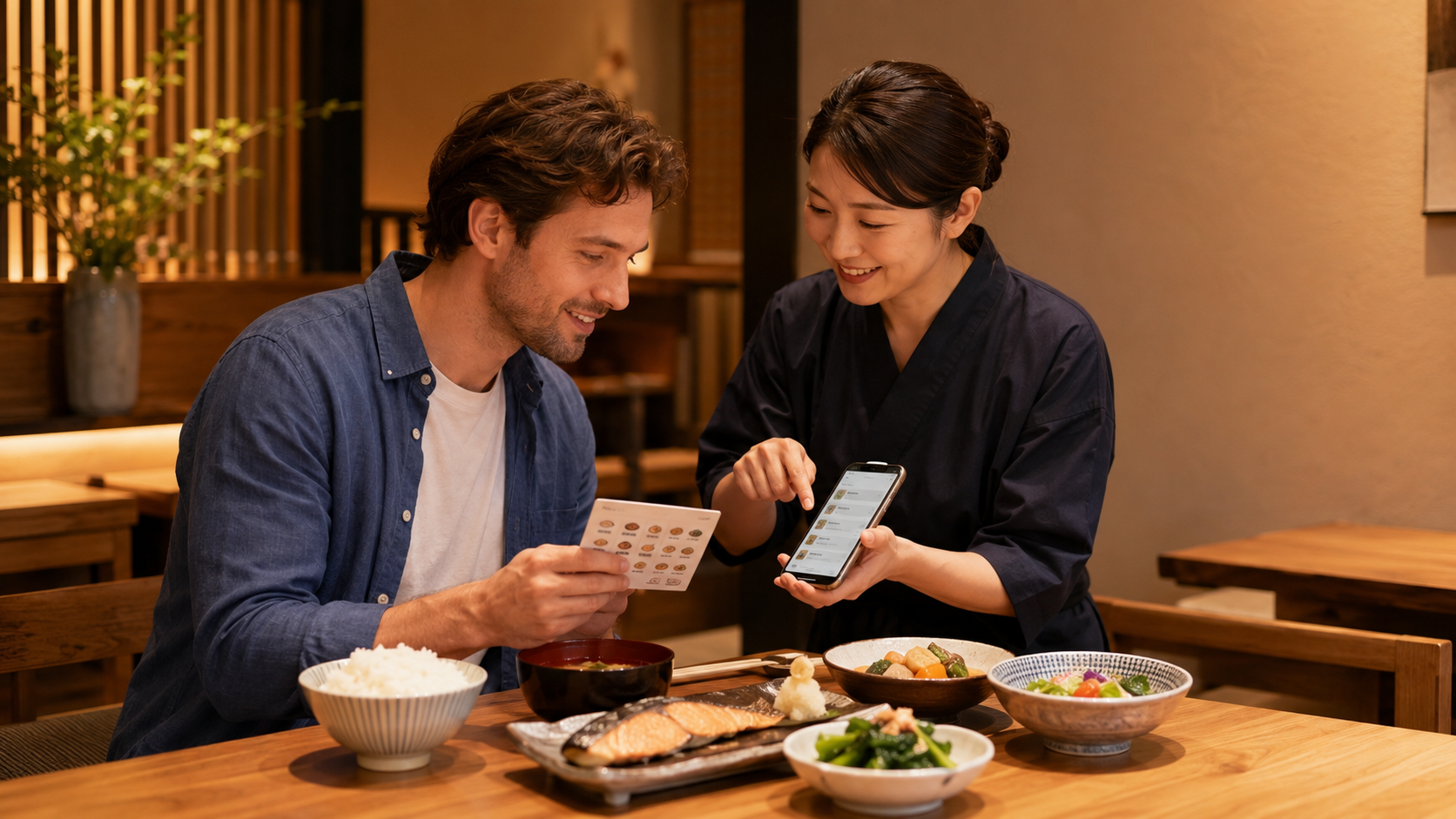
If you have a food allergy and want to eat out in Japan, the quick answer is:
Prepare a written allergy card, show it before ordering, and ask whether the restaurant can safely confirm ingredients. Do not rely only on photos, menu names, or translation apps. Packaged foods may have allergen labels, but restaurants may not always have complete allergy information, and cross-contact can still happen.
If you have a history of severe allergy or anaphylaxis, keep your emergency medicine with you and know how to call 119 in Japan.
Show This First
| English meaning | Japanese to show |
|---|---|
| I have a food allergy. | 食物アレルギーがあります。 |
| I cannot eat this ingredient. | この食材は食べられません。 |
| Is this ingredient used in this dish? | この料理にこの食材は使われていますか? |
| Is it used in the soup, sauce, seasoning, or broth? | スープ、ソース、調味料、だしに使われていますか? |
| Is there a risk of cross-contact in the kitchen? | 調理中に混ざる可能性はありますか? |
| If you are not sure, I will not eat it. | 分からない場合は食べません。 |
| Please call an ambulance. | 救急車を呼んでください。 |
Write your exact allergen names in Japanese on your own card before the trip. A printed card is often clearer than speaking only in English.
Packaged Food vs Restaurants
Japanese packaged processed foods have allergen labeling rules. Look for words such as:
- アレルゲン = allergen
- 特定原材料 = specified allergenic ingredients
- 原材料名 = ingredients
- 含む = contains
As of April 2026, Japan’s mandatory allergen labeling for packaged processed foods includes egg, milk, wheat, buckwheat/soba, peanut, shrimp, crab, walnut, and cashew nut. However, labeling changes can have transition periods, and older packages may still exist.
Restaurants are different. A menu may not list every ingredient, sauce, broth, oil, topping, or kitchen cross-contact risk. If the staff cannot confirm, choose a safer option.
The Consumer Affairs Agency and Tokyo Metropolitan Government provide food allergy communication sheets that travelers can download and use.
Japanese Foods That Need Extra Checking
| Food or situation | What to check |
|---|---|
| Soba | Soba means buckwheat. Soba restaurants may also prepare other noodles in the same kitchen |
| Ramen, udon, tempura, okonomiyaki | Wheat, egg, seafood, broth, sauce, and shared fryers may matter |
| Dashi / soup stock | May contain bonito, fish, shellfish, kelp, or other ingredients depending on the dish |
| Soy sauce, miso, sauces | Soy and wheat are common label checks |
| Sushi and seafood restaurants | Fish, shellfish, roe, soy sauce, wasabi mixtures, and shared tools may matter |
| Desserts and bread | Egg, milk, wheat, nuts, gelatin, and sesame may appear |
| Buffets and izakaya | Shared utensils and mixed menus can increase cross-contact risk |
Do not assume vegetarian, vegan, halal, or “no meat” also means allergy-safe. Those labels are about dietary style, not always kitchen allergy control.
For vegetarian and vegan wording issues in Japan, JNTO also recommends being specific about what you cannot eat.
Safer Habits While Traveling
- Contact restaurants in advance for reservations or set menus.
- Use an allergy card with Japanese text and simple icons if possible.
- Choose restaurants that can clearly answer ingredient questions.
- Keep safe snacks or packaged foods as backup.
- Check convenience store and supermarket labels carefully.
- Avoid complex dishes if the staff cannot confirm the ingredients.
When to Get Emergency Help
Call 119 in Japan or ask someone nearby to call if there is trouble breathing, throat tightness, swelling of the lips or face, repeated vomiting, dizziness, collapse, confusion, or symptoms involving multiple body areas after eating.
If you carry prescribed emergency medicine, follow the instructions you were given by your own doctor.
For medical help in Japan, see: Where Should I Go If I Feel Sick in Japan?
For medical cost and insurance checks, see: Medical Costs in Japan: What Travelers Should Know Before Seeing a Doctor
Bottom Line
For food allergies in Japan, the safest simple plan is:
- Prepare a written allergy card in Japanese.
- Show it before ordering.
- Ask about sauces, soup stock, seasonings, toppings, and cross-contact.
- Use official allergy communication sheets when helpful.
- If the restaurant cannot confirm, do not eat the dish.
Japanese food can be a wonderful part of travel, but allergy safety depends on clear communication and choosing places that can answer clearly.
Related Guides
- Where Should I Go If I Feel Sick in Japan?
- Medical Costs in Japan: What Travelers Should Know Before Seeing a Doctor
- Drugstore Basics in Japan
- Drowsy vs Non-Drowsy Allergy Medicine in Japan
References
- Consumer Affairs Agency, Japan. Food Labelling. https://www.caa.go.jp/en/policy/food_labeling/
- Consumer Affairs Agency, Japan. Food allergy labeling information. https://www.caa.go.jp/policies/policy/food_labeling/food_sanitation/allergy/
- Tokyo Metropolitan Government. Food Allergy Communication Sheet. https://www.hokeniryo1.metro.tokyo.lg.jp/shokuhin/eng/pamphlet/allergy_leaflet.html
- Tokyo Metropolitan Government. Leaflet about food allergy measures for eating and drinking establishments. https://www.hokeniryo1.metro.tokyo.lg.jp/shokuhin/eng/allergy/leaflet.html
- Tokyo Allergy Information Website. Food allergy basics. https://www.hokeniryo1.metro.tokyo.lg.jp/allergy/en/knowledge/food_allergy.html
- Japan National Tourism Organization. FAQ: allergy labels. https://www.japan.travel/en/faq/
- Japan National Tourism Organization. Vegetarian and vegan guide: ordering tips. https://www.japan.travel/en/guide/vegetarian-guide/
- Japan National Tourism Organization. For safe travels in Japan: medical guide. https://www.jnto.go.jp/emergency/eng/mi_guide.html