If you are sick in Japan and wondering “Can I buy antibiotics at a drugstore?”, the quick answer is:
In most traveler situations, you cannot buy oral antibiotics at a Japanese drugstore without seeing a doctor. If an antibiotic is needed, you usually need a clinic visit and a prescription.
Visiting multiple drugstores is unlikely to help if you are looking for oral antibiotics such as amoxicillin or azithromycin. A drugstore can help with OTC symptom relief and safety checks, but it usually cannot replace a clinic when an infection may need prescription treatment.
Also, do not assume that a prescription from another country can be filled directly at a Japanese dispensing pharmacy. If you already have a prescription or a medicine record from home, bring it to a clinic or ask your travel insurance support line what to do next.
This article is a quick guide for travelers. It does not diagnose infections or tell you whether you need an antibiotic.
- Quick Check: Drugstore or Clinic?
- Why Antibiotics Are Different
- What You May See at a Japanese Drugstore
- What a Drugstore Can Help With
- How to Get Antibiotics If They Are Needed
- Important: Do Not Use Leftover Antibiotics Casually
- Useful Japanese Phrases
- When to Seek Urgent Help
- Bottom Line
- Related Guides
- References
Quick Check: Drugstore or Clinic?
| Situation | Better first step |
|---|---|
| Common cold symptoms, runny nose, mild cough, no severe signs | A drugstore may help with OTC symptom relief |
| Flu-like symptoms or COVID-like symptoms | Consider testing or medical care, especially if high risk or very unwell |
| Sore throat with high fever, swollen tonsils, rash, or worsening symptoms | Consider a clinic |
| UTI-like symptoms, especially fever, back pain, blood in urine, pregnancy, or symptoms in men | Visit a clinic |
| Tooth pain with facial swelling, pus, fever, or strong pain | Look for a dentist or clinic |
| Wound with spreading redness, warmth, pus, fever, or severe pain | Visit a clinic |
| Diarrhea with blood, high fever, dehydration, severe abdominal pain, or recent high-risk food exposure | Visit a clinic |
| You lost or forgot your prescription antibiotic | Contact a clinic, your travel insurer, or your original doctor; bring proof if possible |
| You have a prescription from another country | Do not assume it can be filled directly; ask a clinic or travel insurance support line |
Why Antibiotics Are Different
Antibiotics treat some bacterial infections, but they do not work for viral illnesses such as most colds, flu, or many sore throats. Taking antibiotics when they are not needed can cause side effects and contributes to antimicrobial resistance.
In Japan, oral antibiotics used for infections are usually prescription medicines. A doctor may need to check your symptoms, medical history, allergies, pregnancy status, and sometimes test results before deciding what medicine is appropriate.
For Japan’s general medicine sales system, see: Drugstore Basics in Japan
What You May See at a Japanese Drugstore
You may see words like antibacterial, antiseptic, anti-inflammatory, for wounds, for eye infection-like symptoms, or for acne on OTC products.
These are not the same as oral antibiotics for infections inside the body. For example, some OTC products may be for skin care, wound disinfection, eye symptoms, mouth/throat symptoms, or external use only.
Check the label carefully and ask staff:
- Is this for external use only?
- What is the active ingredient?
- Is this an antibiotic or an antiseptic?
- Is this appropriate for my symptom?
- Should I see a doctor instead?
What a Drugstore Can Help With
A Japanese drugstore may help you:
- check OTC options for fever, pain, sore throat, cough, runny nose, stomach symptoms, rash, or mild urinary discomfort
- avoid duplicate ingredients with medicine you already took
- check drowsiness warnings, age limits, pregnancy warnings, and allergy cautions
- explain when pharmacist support is needed
- tell you when symptoms sound better suited for a clinic
For medicine overlap, see: Can I Combine Japanese OTC Medicines?
How to Get Antibiotics If They Are Needed
The usual flow is:
- Find a clinic, dentist, or hospital department that fits your symptoms.
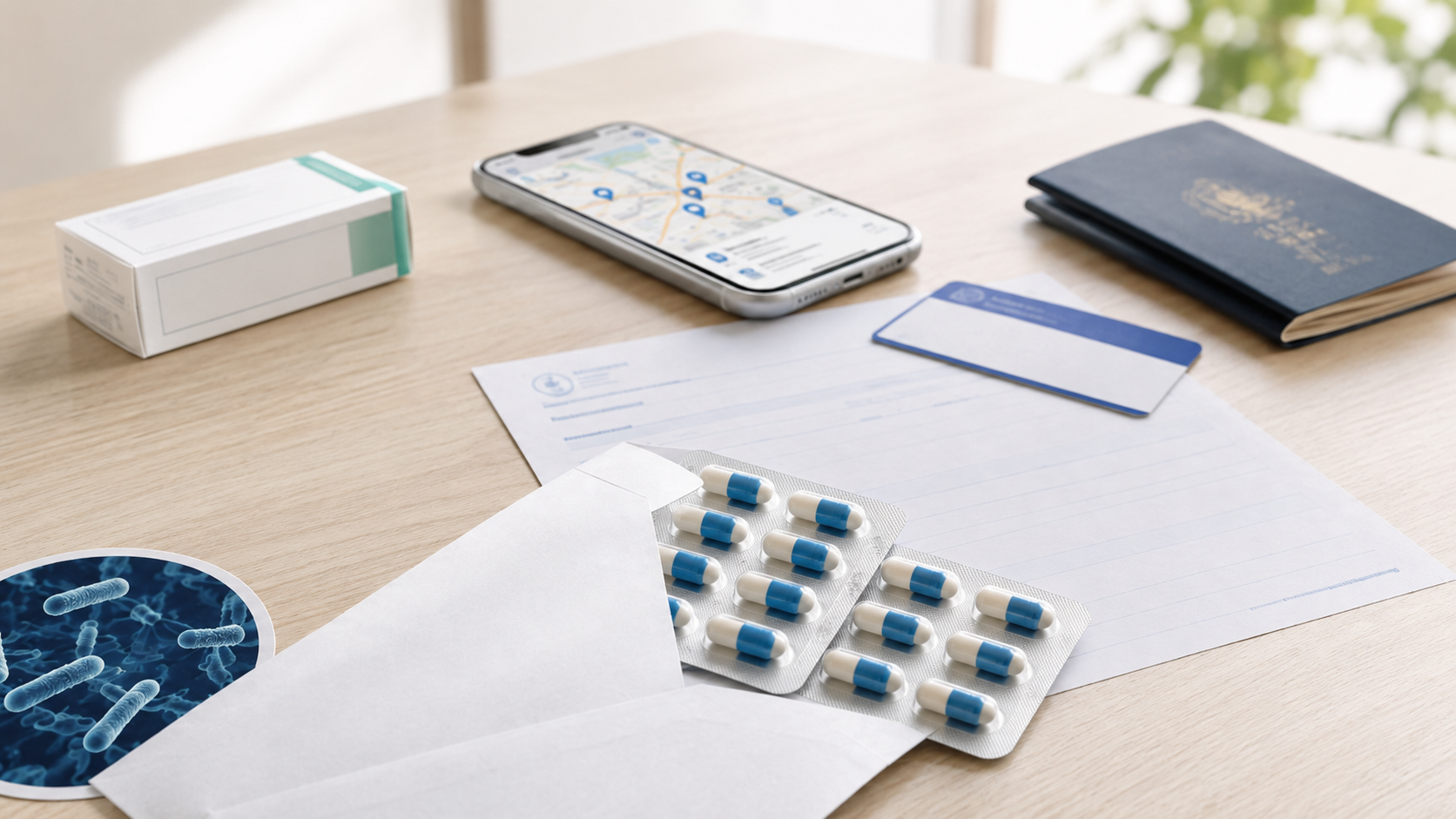
- Bring your passport, insurance information, current medicines, allergy information, and any medicine package, prescription record, or home-country prescription.
- See a doctor or dentist.
- If an antibiotic is needed, receive a prescription.
- Take the prescription to a dispensing pharmacy, or receive medicine at the medical facility if they provide it in-house.
If you already have a prescription from another country, it can still be useful information, but you may need a Japanese medical consultation and a Japanese prescription to receive medicine in Japan.
For help finding care, see: How to See a Doctor in Japan as a Traveler
Important: Do Not Use Leftover Antibiotics Casually
Do not take antibiotics prescribed for someone else, and do not use leftover antibiotics from a previous illness without medical advice.
The wrong antibiotic, dose, or duration may not treat the problem and may delay proper care. It can also cause allergy, diarrhea, interactions, or other side effects.
If you lost or forgot a prescribed antibiotic during travel, see: I Lost or Forgot My Prescription Medicine in Japan
Useful Japanese Phrases
| English meaning | Japanese to show |
|---|---|
| Can I buy antibiotics without a prescription? | 抗生物質は処方箋なしで買えますか? |
| Do I need to see a doctor? | 医師の診察が必要ですか? |
| Should I go to a clinic instead of using OTC medicine? | 市販薬ではなくクリニックを受診した方がよいですか? |
| I may have a bacterial infection. | 細菌感染かもしれません。 |
| I was prescribed this antibiotic before. | 以前この抗生物質を処方されました。 |
| I have a prescription from my home country. | 自国で発行された処方箋を持っています。 |
| Can this prescription be used in Japan? | この処方箋は日本で使えますか? |
| I have an allergy to antibiotics. | 抗生物質にアレルギーがあります。 |
| I have a fever. | 熱があります。 |
| I have a sore throat. | のどが痛いです。 |
| It hurts when I urinate. | 排尿時に痛みがあります。 |
| I have tooth pain and swelling. | 歯の痛みと腫れがあります。 |
| The wound is red and painful. | 傷が赤くなって痛いです。 |
| I am pregnant / may be pregnant. | 妊娠しています/妊娠しているかもしれません。 |
For a broader phrase card, see: Show This at a Japanese Pharmacy
When to Seek Urgent Help
Call 119 or seek urgent medical care if you have trouble breathing, swelling of the face or throat, severe allergic reaction signs, confusion, fainting, stiff neck, severe dehydration, severe abdominal pain, chest pain, rapidly spreading infection, or a rapidly worsening condition.
For emergency numbers, see: Emergency Numbers in Japan
Bottom Line
In Japan, oral antibiotics for infections usually require a doctor’s prescription. A drugstore can help with OTC symptom relief and safety checks, but it usually cannot sell you oral antibiotics like amoxicillin or azithromycin without a prescription.
If symptoms suggest a bacterial infection, are severe, are getting worse, or involve UTI signs, dental swelling, infected wounds, high fever, or blood in stool or urine, look for a clinic instead of relying only on OTC medicine.
Related Guides
- Drugstore Basics in Japan
- How to See a Doctor in Japan as a Traveler
- Show This at a Japanese Pharmacy
- Can I Combine Japanese OTC Medicines?
- UTI Symptoms in Japan
- I Lost or Forgot My Prescription Medicine in Japan
- Emergency Numbers in Japan
- Medical Costs and Travel Insurance in Japan
References
- Ministry of Health, Labour and Welfare. Antimicrobial resistance (AMR) measures. https://www.mhlw.go.jp/stf/seisakunitsuite/bunya/0000120172.html
- Ministry of Health, Labour and Welfare. Information on the Japanese medicine sales system. https://www.mhlw.go.jp/stf/seisakunitsuite/bunya/0000082514.html
- Pharmaceuticals and Medical Devices Agency (PMDA). OTC medicine package insert search. https://www.pmda.go.jp/PmdaSearch/otcSearch/
- CDC. Healthy Habits: Antibiotic Do’s and Don’ts. https://www.cdc.gov/antibiotic-use/about/
- Japan National Tourism Organization. Guide for when you are feeling ill in Japan. https://www.jnto.go.jp/emergency/eng/mi_guide.html